
Sleeping in
enjoying dream embraces
of a book boyfriend when
the doorbell rings
with delivery of the next instalment
in the relationship.
Sleeping in
enjoying dream embraces
of a book boyfriend when
the doorbell rings
with delivery of the next instalment
in the relationship.
Oh, belligerent woman
at the gas station.
You know you are wrong.
You see the arrows.
Instead of backing up
You drive forward,
and make obnoxious remarks.
The other ten of us
can follow directions.
One of these things is not
like the others.
You’re embarrassed.
I get that.
So apologize, and back up.
Don’t yell at me.
I’m going the right way.
I am an author, though.
So while you rant,
I have the satisfaction
of seeing the bomb
the terrorists have set
that you accidentally trigger
by going the wrong way.
As your car explodes in a fiery
conflagration,
the ten cars that are secure
in our rule following
are protected by our bubble of sanctity.
We smile contentedly
knowing karma is at work,
as the litter of your dissatisfied life
rains from the sky,
bouncing off of us and
our aligned automobiles.
As you back out,
muttering a chastened,
“Sorry,”
I am glad that imagination
trumps aggravation
every time.
.
.
It’s a popular saying, “Don’t mess with authors. They will put you in their novels, and kill you.” Today, I discovered the poetic equivalent. 😉
 Let me introduce you to the amazing Ann Walsh, a prolific BC writer of nine novels for kids and young adults. An has also co-written a non-fiction book about forestry, and was editor of two short story anthologies. Her most recent novel is Whatever.
What inspired you to begin writing?
I always wanted to be a writer. Then one day I found myself fast approaching 40 and realized it was time to get on with my dream. So I took a 6 day writing course in Wells, just outside the restored gold rush town of Barkerville, with a wonderful teacher, Robin Skelton. Wells forms the setting for much of my first book, and I still carry a picture of Robin in my wallet, with the photos of the grandkids.
The first book you published was a lovely teen novel called Your Time, My Time that was set in the historical town of Barkerville. Having read the book, I’ve never been able to go past the old Barkerville cemetery without getting goosebumps. You’ve written four stories set in Barkerville. Can you discuss the importance of special places in inspiring story?
Thank you for those kind words. Barkerville still gives me goosebumps, the whole town, not just the cemetery. The first time I ever saw it, in the early l960s before the road in was paved or even more or less straight, I knew that it was a special place, one where the past and present nearly touched. In YTMT my protagonist, Elizabeth, expresses that feeling. She says “It’s as if the old times are jealous of the new and want to be, not the past, but the here and now.” Or words similar to that. That feeling of the past ‘looking over your shoulder’ still haunts me in Barkerville, and in some other historic places.
In your own books, who is your favourite character? Why?
Percival Theodore MacIntosh and Moses (from Moses, Me and Murder) and I have travelled together a lot, and done many, many school presentations together. They are my most entertaining characters. But my favourites change. Right it is Janie Johnson, an elderly (that means older than me) woman who is a central character in my new YA, Whatever.
What author do you read over and over again?
Arthur Conan Doyle; Shakespeare
You’ve recently been studying in Victoria. Why do you feel continuing education is important for an author?
Books need fertile ground in which to grow. A stagnant brain isn’t receptive to the seeds of ideas. I loved re-discovering Shakespeare’s words and themes and had an introduction to Women’s Studies. My brain woke up and a book was finished.
Do you have a favourite writing quotation to share?
“Writing is easy. All you do is stare at a blank sheet of paper until drops of blood form on your forehead.”
`Gene Fowler
What do you like about writing for children and teens?
Recently I met a young mother and her two small children. She had been searching for a copy of Your Time, My Time to re-read because it had made such an impact on her when she was a teen. I signed a new copy of the book to her young daughter, even though it will be many years before the toddler can read it. When you write for young people your audience is always new and always changing. One day a teacher contacts you, one day a grown-up fan, one day an Indo-Canadian boy translating for his father who has limited English but who wants to know if a certain part of Shabash! is true. It’s a wonderful audience to write for, and young people are generous in their praise. My favourite quote, make by a young girl who must be in her 20s by now, is “Ann Walsh, do you know you’re world famous in Kamloops?”
What has been the most interesting thing that has happened to you because you are an author?
A difficult question. I’ve driven all over BC usually by myself, met people I’d only heard of like Margaret Atwood, Ann-Marie MacDonald and Farley Mowatt. I’ve danced with Pierre Berton, and eaten breakfast with Robert Munsch. I’ve learned so much, about writing, about people and about myself. It’s been a wonderful career, and I wish I’d started when I was younger so I’d have longer to write. However, I’m not done yet!
Which of your books was the easiest to write? Why? (or if you prefer, What is the easiest part of the writing process for you?)
Moses, Me and Murder! was easy and fast to write (after all, most of the story is true, there wasn’t an decision to be made about the ending for me to wrestle with.) However, it took over 5 years to sell to a publisher and got scathing reviews from ‘literary’ reviewers. It was first published in 1984 and, much to my delight, has just been re-issued as a new edition with a different publisher.
Which of your books was the most challenging to write? Why?
Whatever was difficult for me because in it I deal with the issue of aging as well as the Restorative Justice process.
What is the most asked question when you’re doing author visits in schools?
In every session someone asks at least one of the following three questions: “How old are you, how much money do you make, where do you get your ideas?” I now answer them before the question period begins—seventy one, not very much and anywhere I can, in case anyone else wants to know.
Thanks, Shawn. This was fun!
(Note from Shawn: I am SO JEALOUS that you danced with Pierre Berton and had breakfast with Robert Munsch!)
 Here is a blog chain contribution by Carol Mason. Carol’s website is being stubborn, so we’re posting her responses here. 🙂
Thanks to author Shawn Bird for inviting me to participate here. You have asked some really great questions!
1. What inspired you to begin writing?
When I was graduating university, a fellow student was about to start writing Harlequin Romances. She believed she could write one easily, and that it would be a fast way to making money. Of course, she was deluded, as I’m sure she later learned. Writing is not easy, be it literary fiction or a Harlequin bodice-ripper! And getting published is even harder. But it planted the seed. I’d always wanted to write. So I thought, Ok, if she’s going to try it, maybe I will too…. (I started to try to write Harlequins then wondered what on earth was I doing! I didn’t even enjoy reading these books. But it gave me a starting point until I found my feet so to speak and discovered that it was women’s contemporary fiction that was my calling, not necessarily romances.
2. How does being a British ex-pat living in Canada impact your writing?
My voice is very British. Despite living in fabulous BC for many years, I still feel very British. But I want my books to be sold in more countries than just the UK so I have to remind myself not to use words that are too regional. Sometimes I try to sound more North American but it feels wrong. We have to be who we are at the end of the day, don’t we? That is never more true than when it comes to writing…
3. In your own books, who is your favourite character? Why?
I loved Leigh in The Secrets of Married Women, my first novel. Leigh is a bit of a dark, complicated woman, capable of having great fun and being a great friend, yet equally capable of deceit at the worst level. This makes her fascinating to me. Writing her, I was intrigued by what she was going to do next and how her friends seemed to underestimate her until there was an eye-opening event that changed everything… As far as my male characters go, then Mike in The Love Market. Mike is not your typical hero. He’s not tall. He’s not especially good-looking, or successful or ambitious, and he’s got strange dress sense. But no one could love their wife as much as Mike loves his wife – or, now, ex-wife. He’s the kind of guy we all want in our life – as a 100% reliable friend, definitely. As a romantic interest… well, you would have to decide. Yet as we discover, Mike might be a nice guy, but he’s not a door mat. Mike has a breaking point that gave me as an objective reader of my own novel, tremendous respect for him.
4. What author has inspired you?
So many! Rosie Thomas, initially. I remember reading her novel Other People’s Marriages and thinking Whoo! This is the kind of book I want to write! Then I read all of hers and didn’t dislike any of them. I have read so many novels yet this one always sticks in my mind for some reason. Then chicklit came along and some of it was good and so much of it was bad… I never totally latched onto a great, great chicklit author, preferring the more complex stories of the type Rosie writes.
5. You frequently write about your travels on your Facebook page. What is your most memorable travel story?
Just the other day my husband and I were recalling our visit to Tuscany 2 years ago, and laughing about this. We were in the very charming Montepulciano, and it was April and not especially warm. There were few tourists around and we were looking for a place to eat dinner. A charming young Italian lured us into his restaurant with a very long and engaging speech about the purity of his ingredients, his wife’s skill as a chef, and a certain kind of local and rare wild boar that his wife specialized in cooking. (my husband speaks Italian). Anyway, we love our food and his restaurant sounded amazing, so we dutifully trotted back there at 7pm when he opened for dinner. Basically it was a small place of about 10 tables, and his wife worked the kitchen and he worked the floor. There was no other staff. We were to receive a 5 course meal he told us, but little did we know that each course would be introduced with a lengthy description of the origins of the food, his wife’s rationale for pairing ingredients, the history of the various condiments that were served with each course…..a twenty minute lecture on the various types of wine that would accompany each dish… It was a bit like going to cooking school, only instead of the teacher addressing a classroom, this young man addressed each table individually, repeating the same story with everyone who walked in the door, which left him little time to actually serve food. By the time all 10 tables were occupied and he’d repeated his spiel 10 times, we had been in there two hours before we’d even seen the first course – a rather disappointing pasta with dry bits of beef in it. The build-up to his famous wild boar main course was almost more than any of us could stand. Wasn’t that the real reason why we were all here? We had certainly worked up an appetite. My husband and I were salivating with anticipation, as were the two Americans at the table next to us. I had a feeling we were in for something fabulous that would live in our memory for years to come as our truly authentic gourmet experience of Italy. I even had my camera at the ready. When the boar finally arrived, my husband and I looked down at our plates just as we heard the American woman say, “It’s a slice of ham!’ And it truly was. No adornment. No accompaniment. Just one, thin, flat, pink slice of pleasant-enough but highly boring old ham. We suffered through the courses that followed – each one more underwhelming than the one that had gone before. Then the chef came out to take a bow! Yes. And we applaud her because we felt so bad for her, plus we were just glad the whole thing was finally over. I could have gone to the theatre and had dinner and after-theatre drinks in the time we sat there. We weren’t let out until nearly midnight. I suppose I should have known – you know, Boar=Ham. But somehow, being in Italy, and being wooed by a handsome young restaurateur who seemed so passionate about food, I had hoped for a fabulous experience. Well, an experience it was, but fabulous, not so much!
6. Do you have a favourite writing quotation to share?
“If you can’t tell stories, create characters, devise incidents and have sincerity and passion, it doesn’t matter a damn how you write.” Somerset Maugham. Because it’s true. Being a good writer is not even close to enough.
7. What do you like about writing for ‘women’s fiction’?
I can explore issues that interest me, or ones I’ve personally had experience with, or am familiar with through my encounters with friends. I can really get into that endlessly fascinating territory of what makes women tick – the good, the bad and the entirely preposterous. I don’t have to do massive chunks of research. Nobody is going to think I’m an idiot when I wrongly interpret history. Sometimes I get to shock people because they assume I’ve experienced everything I write about! If only that were true!
8. What has been the most interesting thing that has happened to you because you are an author?
For the launch of my first novel, my publisher, Hodder, invited me to The Grove (a very posh destination spa/resort in England) for a media event. It was attended by 10 other authors – many of whom I admire, and whose novels I have read. It was a fancy event with many of the country’s major media present, complete with an overnight stay and fabulous meals with ever-flowing champagne. I felt so privileged to be included among so many successful novelists. I could never have afforded to stay there if the publisher hadn’t been paying. I got to dress up. I wrongly assumed a writer’s life would be glamorous like this everyday. It isn’t. But I still wouldn’t change a thing about it.
9. Which of your books was the easiest to write? Why?
Send Me A Lover. For some reason I really related to the young widow who wanted so badly to believe her husband was up there looking after her and helping her find new love. Plus it includes a lovely trip to Greece where I had recently been. And the young widow’s mother is a lot like my own – so I felt I could write their quirky dynamics so easily! It was a funny and sad book that somehow just flowed for me.
10. Which of your books was the most difficult to write? Why?
I think my first one. Or at least, the first one to get published (The Secrets of Married Women). Mainly because I had what I thought was a structure, then it had to change as my editor at my literary agency thought it wasn’t working. Then it went through so many edits when my agent found me a publisher. I constantly felt like it was 100% good enough, only to be told that I still had far to go before it was up to the standard it needed to be at. It really showed me how you can write a good book, in fact a knockout book, but there are lots of other published writers out there writing knockout novels, and the competition is very very stiff. If you’re not as good as the best, then you simply aren’t going to compete. You won’t get published. Then you won’t stay published.
11. I remember you telling me that someone broke into your house and stole your computer, and the two completed novels on it. Was losing those works a blessing or a curse in the long run?
Those were the two Harlequin novels I wrote in the very beginning! I was really just cutting my teeth on them. I learned how to start a book, finish a book and give a book a middle. So that was valuable, of course. At the time it felt like a huge trauma to have them stolen. But really, it was probably a blessing. I really don’t think they were all that great anyway!
Next in the chain!
I am going to ask 11 questions of Kim Hornsby, author of The Dream Jumper’s Promise and Necessary Detour, to name two. http://www.kimhornsbyauthor.net/ Kim, here goes…
1. Describe the type of books you write, as I believe you also write under a pen name.
2. You were once photographed with Sylvester Stallone. Is there something about you that we need to know?
3. What is your ultimate dream as a writer if you could map the course of your writer’s career?
4. What is the best novel you have read recently and the one that disappointed you the most, and why?
5. Describe your writing process – to plot or not to plot, before you begin?
6. Since you first started writing, up until now, how would you say you have grown as a writer?
7. How do you come up with a book idea?
8. How secure are you as a writer (given that creative people are thought to be quite insecure about their art)? If you had a great book idea and 5 of your writer friends shot it down, would you write it anyway?
9. Without giving away any plot, what is your favourite scene in a book you’ve written?
10. If you were forbidden from writing novels, what would you do that might come close to satisfying you?
11. Tell me about Beach Read Authors. What can readers hope to find there?
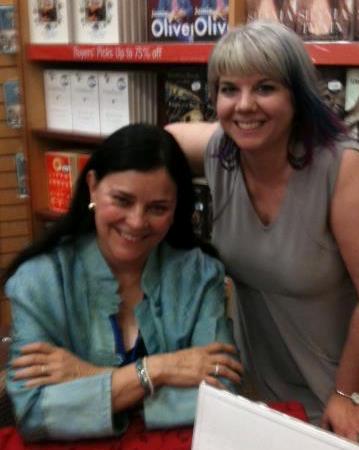
Diana Gabaldon and I at the Strawberry Hill Chapters in Surrey: a gala fund raiser for the Surrey International Writers’ Conference. This was a nice opportunity to chat a bit with her, as I visited with all of the other authors, waiting until the crowds were gone to speak to her. Since we’ve been corresponding for a few months, she knew who I was and was very welcoming.
Now to get a good night’s sleep before falling off the deep end into the conference!
PS. You can’t see them, but there are new Fluevogs on my feet after a pilgrimage to the Gastown Fluevog HQ… 🙂 (It’s been a very happy day celebrating my addictions).
PS2. I didn’t even hyper-ventilate when I met her, although coming home I wondered if I was having a heart attack. After determining I simply did not have TIME to fit in a heart attack this weekend, I decided it was the Thai chicken wrap I had for dinner. 🙂
PS3. This trip was partially to help me prepare psychologically for my Blue Pencil session two days later. You might be interested in reading the post Diana Gabaldon Said To Me as well
PS4. I was also amused to meet Diana’s son Sam Sykes, who wasn’t an official author at this event. He’s amusing.
In July, I discovered author Brian Katcher’s work while browsing the stacks of my local library’s YA section. I enjoyed his Almost Perfect so much that I ordered Playing with Matches. I really enjoyed it, too. I was pleased when I posted reviews here, that Brian stopped into the blog to say hello, and he was willing to do an interview with me. Of course, I managed to procrastinate for a month or two, but at long last, here are the fruits of that serendipitous discovery in the stacks.
Part two will appear tomorrow!
Interview with Brian Katcher:
Your protagonists are very realistic young men with very unexpected challenges to their romantic theories. In some ways they have similar attitudes and expectations. How are Leon (from Playing with Matches) and Logan (from Almost Perfect) similar to and distinct from each other?
Thank you for interviewing me. You know, the problems of Leon and Logan are both so similar, sometimes I feel like I’ve written the same story twice. They’re two young men who want nothing more than to meet a girl who could be both their girlfriend and their friend. And when they find her, they end up losing her because of an issue that, in retrospect, should not have been a deal breaker. As for their distinctiveness, I think Logan was the slightly more mature of the two. He’s had a rough home life and is more worldly and less trusting.
In Playing with Matches, Leon has to sort out the privilege of dating the cheerleader against the honour of having a true friend with physical imperfections. Part of his dilemma relates to the pressure of ‘what everyone else will think.’ How do his choices reflect what you see in the boys at the school where you work?
Actually, I work at an elementary school, but I remember those feelings well from when I was a teen. I don’t think there’s a man alive who didn’t once see a girl they’d really have liked to have asked out, but then thought ‘but she’s overweight/plain/dresses funny/isn’t cool. What will the guys think?’ And we’ve all lived to regret it. And nine times out of ten, the same guys who’d make fun of you for having an imperfect girlfriend are the same ones staying home watching TV weekend after weekend. The older you get, the more you realize that you want to date someone who you enjoy hanging out with. And by then, all you can do is look back and the wasted opportunities and try to learn from them.
Of course, I remember similar behavior in girls, as well. My incredibly smart and talented sister used to act dumb around the popular kids so she wouldn’t be thought of as a nerd.
In Almost Perfect, the story explores Logan’s feelings when he discovers the new girl he’s wildly attracted to, is biologically male. The story could have been about Sage’s journey to become herself. Did you consider telling it from Sage’s point of view? Why did you choose to tell Sage’s story from Logan’s perspective?
In my original draft, I punctuated the chapters with excerpts from Sage’s diary, detailing her feelings about Logan and their relationship. However, since I did not reveal that Sage was transgender until page 100, I had to deliberately not mention a lot, which was kind of jerking the reader around. In the end, I used Logan to tell Sage’s story. I felt more comfortable writing from the point of view of a young man who was meeting someone like Sage for the first time. I considered writing from Sage’s point of view, but I feared that I wouldn’t be able to accurately capture the first person feelings of a young transwoman. The last thing I wanted to do was make Sage an unrealistic character.
See the rest of the interview tomorrow!
This is purely selfish, I know.
Since October 2011, I’ve been obsessed with author Diana Gabaldon and her Outlander series (though I read anything by her I can find: the Lord John series, blog posts, articles, tweets, Facebook postings). Like millions of rabid fans around the world, I am waiting desperately for the next installment in in the adventures of Claire and Jamie Fraser, et al. Written in My Own Heart’s Blood (aka MOBY) isn’t due until SEPTEMBER 2013!
>>Insert anguished groan here<<
Recently, Diana went to Scotland to celebrate the wedding of her daughter. I found myself praying passionately that there would be no plane, train, bus, ferry, or auto accidents. What if Diana was to expire in some sort of dramatic, Fraser worthy way? She puts her characters through enough, fate might just mock her with an ironic twist, and she could be caught in such a scenario up close and personally! Worse, some ignominious event could fell her, some blip of biology could shut down that brilliant brain and still that witty pen.
😦 NOOOOOOOOO! The very idea makes my heart pound in dread.
Yesterday, in my audio book of Gabaldon’s Drums of Autumn, Jamie fought off a bear with a dirk, bare hands, and sheer determination. (Claire contributed to his defence by whacking at the combatants with a dead fish). After this attack, Claire shakily observes,
Anytime. It could happen anytime, and just this fast. I wasn’t sure which seemed most unreal; the bear’s attack, or this, the soft summer night, alive with promise.
I rested mv head on my knees, letting the sickness, the residue of shock, drain away. It didn’t matter, I told myself Not only anytime, but anywhere. Disease, car wreck, random bullet. There was no true refuge for anyone, but like most people, I managed not to think of that most of the time.
I am not a worry-wart. I have a generally relaxed, laissez-faire attitude about most things. I believe in doing what you can, and then letting go. I wait without anxious fear for results of jobs, test results, admissions, reviews, and queries. Impatient curiosity may cause frustration, but not anxiety. My kids and husband are on their own, provided only with my good wishes and sensible advice. I never panic over their prospective demises, despite their penchants for death defying recreational activities that would indicate I really should. Yet, Diana Gabaldon’s books can keep me up all night, fretting about how things are going to turn out for a character who’s stuck in another impossible situation. Her fictional world stresses me out far more than the real world does.
I love her for it.
So I worry about Herself .* This is slightly absurd, and definitely selfish. I know it, and yet I can’t help it.
Please be immortal, Diana. Or at least, get yourself into a time loop next time you’re in Scotland. I recommend looking for wild flowers at the base of standing stones around Beltane.
—
*I also worry, not infrequently, about Davina Porter, narrator of the Outlander audio books, for much the same reasons. She HAS to keep narrating this series! She can’t die or retire!
Imagine my head, cupped in my hands, shaking in embarrassment. This is quite pathetic, but very real. Am I alone in this absurdity? Tell me someone else shares author anxiety?
July/2013 Especially now that MOBY won’t be released until March 2014 now!
“Man is least himself when he talks in his own person. Give him a mask, and he will tell you the truth.” Oscar Wilde
It’s an interesting idea, don’t you think? I can see how character and philosophy oozes out from between the lines of an author’s work. I know that people who know me laugh when they read my work, because they can hear my voice in the style.
What do you think? Do you think you reveal more about yourself by your action and writings (particularly writing in character) than you do when responding to others?
PS. Still looking for the short story “Masks” as per this blog



 Shawn L. Bird
Interview with Brian Katcher, Part two September 18, 2012
Tags: almost perfect, author, Brian Katcher, interview, Playing with matches
Here is the rest of my interview with author Brian Katcher:
In my experience, there is a germ of truth from our own lives in every book we write, and each character we craft. Where are the germs of truth in Playing with Matches and Almost Perfect? What were the geneses of the stories?
How do you write? i.e. Are you a linear writer? Do you use outlines to pre-plan? Do you write in scenes and integrate them later in the process? Do you have a regular writing routine? If so, what it is? If not, why not?
You also work as a school librarian. We have seen our government cut funding to libraries and non-enrolling teachers in the names of austerity and progress. In their minds, libraries are outmoded and unnecessary. In your experience, how important is the library to students? How are libraries changing to continue to be relevant? What do you as a librarian contribute to kids’ growth and development?
Share this: