
#microfiction challenge to write 30 thirty word stories during April in response to a daily prompt
She isn’t sure who she is anymore.
She is a daughter. She is a wife.
Once, she was going to be a mother.
Now she just feels hollow and lost.

#microfiction challenge to write 30 thirty word stories during April in response to a daily prompt
She isn’t sure who she is anymore.
She is a daughter. She is a wife.
Once, she was going to be a mother.
Now she just feels hollow and lost.
A writing challenge on Twitter to write a 30 word story each day in April, following prompts.
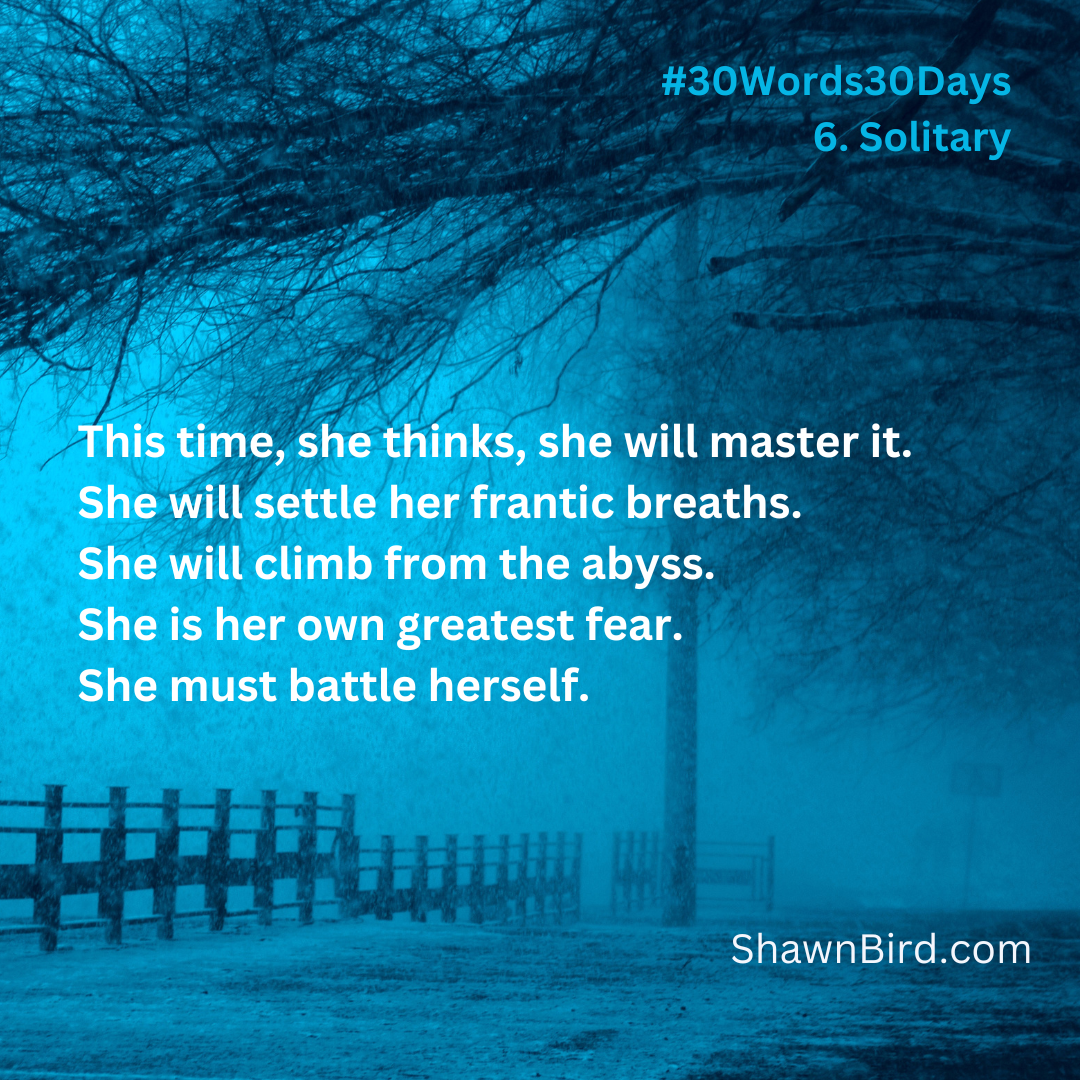
Day 6: Solitary
This time, she thinks, she will master it.
She will settle her frantic breaths.
She will climb from the abyss.
She is her own greatest fear.
She must battle herself.
30 Words30Days prompt #5 Outcast.
He definitely feels he’s been cast out to give her time to discover contentment in solitude.
How paradoxical: he gets a far-flung journey; she learns to bide peacefully with herself.

#30Words30Days. Day 4 prompt: Gather
.
Come morning, I gather what remains of our life and return to the car.
When I’m alone, I’m never lonely.
She gathered her loneliness around herself.
What’s she feeling now?

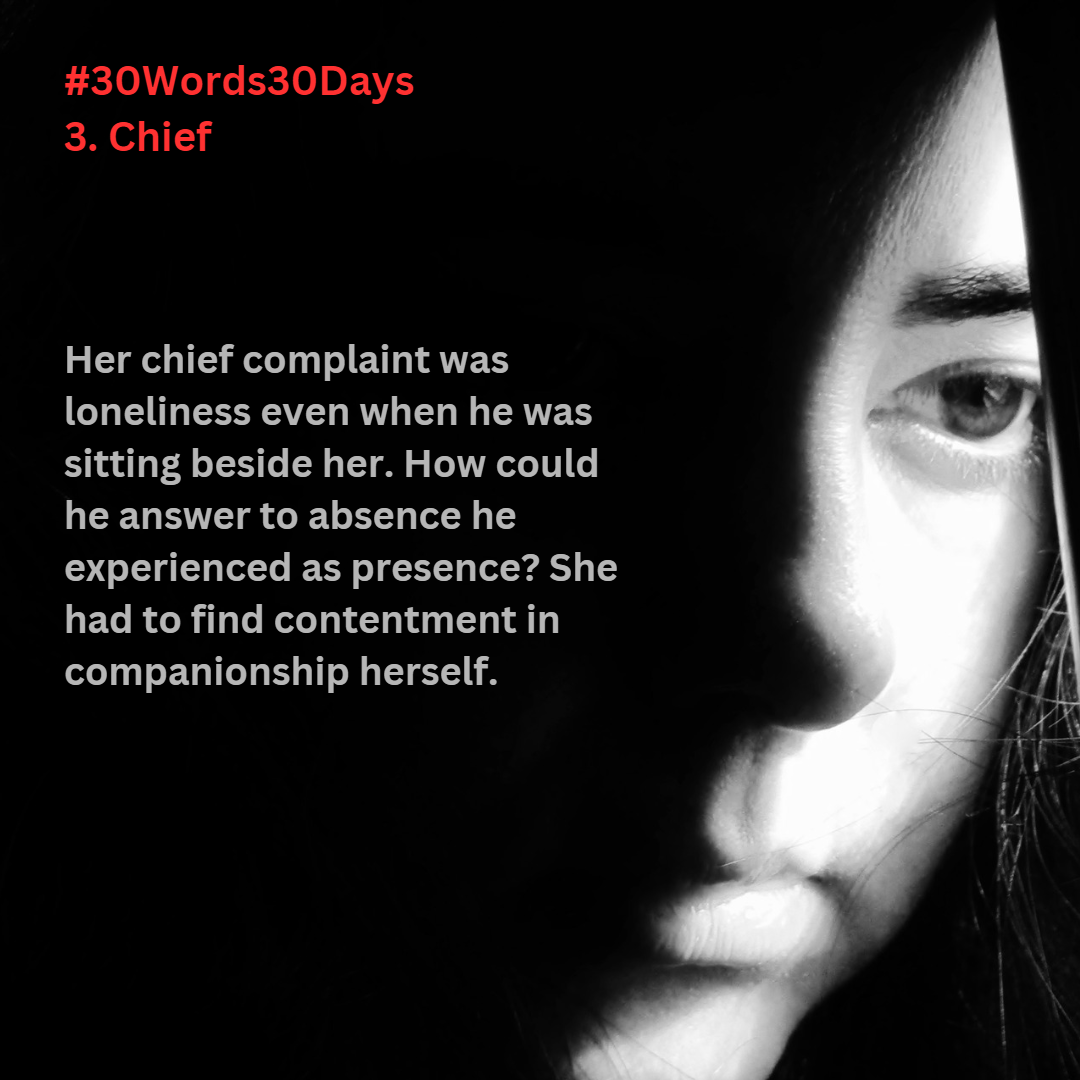
#30Words30Days Day 3 prompt: chief
Her chief complaint was loneliness even when he was sitting beside her.
How could he answer to absence he experienced as presence?
She had to find contentment in companionship herself.
#30Words30Days prompt from https://twitter.com/pleomorphic2
Each day in April Sumitra (pleomorphic2) will post a prompt on Twitter. Participants are to respond with a 30 word story. Follow along and see how it goes!
2. Communicate
The publican doesn’t understand my words, but I mime sleep; he pulls out the ledger. I mime drinking; he pulls a pint.
I’ll be okay here, if my luck holds.

#30Words30Days prompt from https://twitter.com/pleomorphic2
Each day in April Sumitra (pleomorphic2) will post a prompt on Twitter. Participants are to respond with a 30 word story. Follow along and see how it goes!
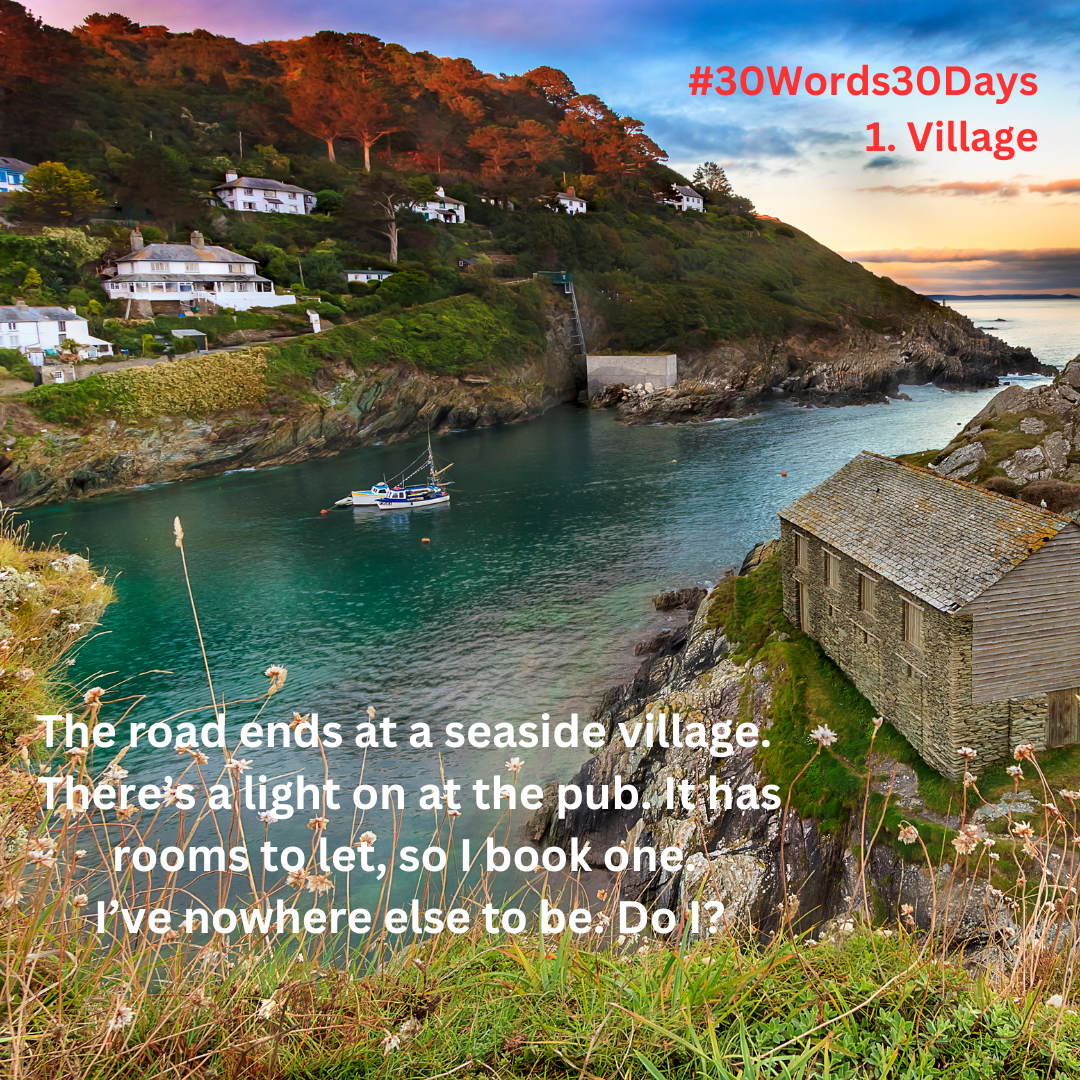
1. VILLAGE
The road ends at a seaside village.
There’s a light on at the pub. It has rooms to let, so I book one.
I’ve nowhere else to be. Do I?
Patience is a virtue is proven in this one!
After a couple years of yearning whenever a new copy of a favourite literature magazine arrived, thinking “I wish I could be published in this,” I finally told myself that to make it happen, I would actually have to submit something. I had a story that I thought would be a good fit, and sent it off March 2021. At that time, their site said they respond within 3 months.
At 6 months when I hadn’t heard, I thought it was probably a good sign, that it might have been put into a ‘maybe’ file. At 9 months, I sent a note and asked about the piece.
In January 2022 I got a decline on the story. I was sad, because I still thought it was a really good fit for them, but that’s just the way things work. I pondered sending it elsewhere, or releasing it as one of my Minute Reads. But I didn’t get around to it.
Last week I got an email asking if the story was still available. 13 months after submitting.
So yay! Sometimes things work out unexpectedly. You never know who at a publication will say, “But what about that story, wouldn’t it work here?”
Submit pieces you know would be good fits, and the editors may (eventually) agree with you! 🙂
After the contracts are signed, I will let you know where to get your copy!
Here’s a peek at my writing zone.

The desk was built by my grandfather about 70 years ago. I inherited it when my mom died last summer. I was so happy to find an ergonomic (tilting!) keyboard tray with a swing-away mouse pad that fit between its drawers, so I can fit my ergnomic keyboard and mouse, and it tucks right up underneath when I’m done working.
The bookshelf shows a bit of my collection of writing resources, some practical, some fun!
Close ups of my (custom) mug and my needle-felted desk poodle, made from some of OJ’s wool, and finally a shot out the window of a pretty sunset over the hills earlier in the month.
My desk has to be in its own room, because I am too messy to work in a public zone. (Yes, I tidied before taking the photo!)
Do I work at this desk all the time? No. I will also work out on my porch swing in the summer, in the bath (using a full-size waterproof keyboard) or on my living room couch. However, if I’m doing a lot of writing or particularly formatting, the ergonomic set-up is important for avoiding pain. I never write in coffee shops, because I live in small place, so people are always interupting to visit. 🙂
If you’re a writer, what does your desk look like?
November swiftly approaches, and for writers around the world that means the question hovers, “Should I participate in National Novel Writing Month?”
In case you’ve not heard of this event, it’s promoted on NaNoWriMo.org as a way to encourage folks to accomplish their dream to write a novel. The challenge is to complete 50,000 words in the month.
That’s 11, 669 words a week.
That’s 1667 words a day.
For 30 days.
Those who complete a 50,000 word manuscript ‘win’ and are eligible for assorted prizes from writing related businesses. (Those who participate but don’t ‘win’ are also entitled to some prizes)
It’s good to be able to plot your progress on the graph and see your project grow.
It’s empowering to be productive.
But…
It’s also a slog. My non-writing friends don’t like my social media feed during NaNo because it’s all about word-count, recalcitrant characters, exhaustion, and frustration.
Because it’s all about word-count, I’ve noticed my writing quality suffers. I have four NaNo ‘winning’ books in my computer that my editors and I have not been able to make publishable yet. There is something fundamentally off about them. I blame the pressure of NaNo. They’re not ‘winners’ to me, because they’re still sitting there in the computer years later.
When I was writing my first novel, within 3 weeks I realized I had settled into a pace, so I made that pace my quota. 1200 words per day Monday to Friday. 6000 words a week. On the weekend, I could catch up, or get ahead as I liked, but I didn’t have to write if I didn’t want to. I had days off if I’d earned them by keeping to my quota. This system worked brilliantly, and the 155,000 word novel was finished in 6 months. (It was 23 weeks, specifically, that averages 6740 words a week).
It was good. I pitched it successfully to a publisher six months after I finished it. It’s an example of ‘slow and steady wins the race.’
I have 13 books in the world, and none of them were NaNo projects. My NaNo projects remain problematic.
So be careful.
If you’re going to embrace NaNo, here are some suggestions:
I have learned that NaNo is not good for my writing practice. I happily participate in the April and June Camp NaNo events when one can set personal goals, and the projects I’ve done then have been completed and published.
These days I don’t feel guilty for letting November go by as I wave at my frantic colleagues. I’ll plug away on my projects without stressing over word-count, and know I’m producing something better than I could do at NaNo pace. I wouldn’t have learned this if I hadn’t tried so many times, though, and seen the unfortunate pattern. It’s worth doing to discover whether it’s a pace that works for you.
Do or do not, it’s up to you!
How about you? Have you done NaNo? What was your experience?



 Shawn L. Bird