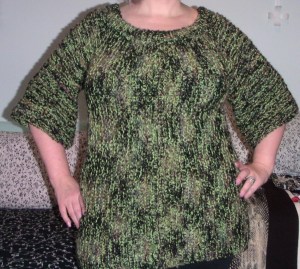
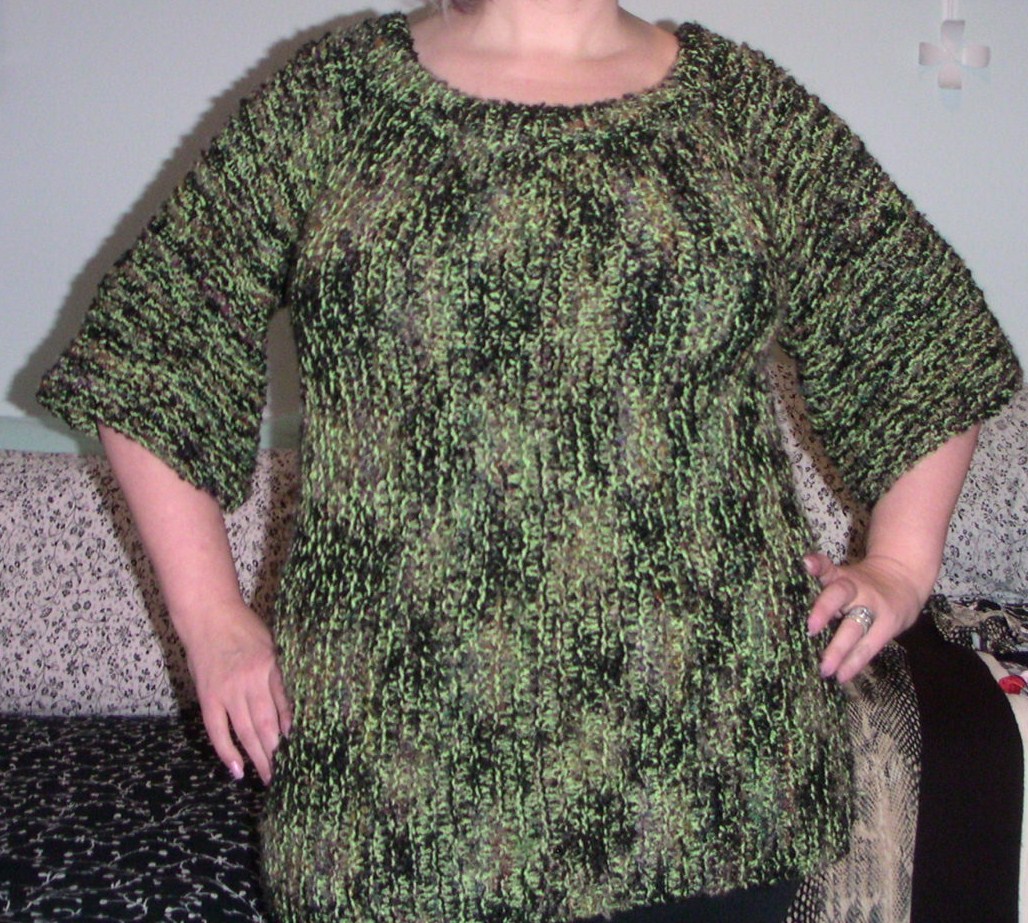
 So– um. People have asked me for the pattern of this sweater, but since I kind of make it up as I go along, it’s a bit tricky to share. I’ll do the best I can!
You’re going to have to already know how to knit to follow these instructions, because you’re going to need to be experienced enough to modify it if you don’t think it’s working for you, and to have a clue what I’m talking about.
First- I found this yarn in a bargain bin at Zellers- 3 balls for $5.99. I have no idea of its name, brand, weight, etc. There are two different yarns knit together. One is a varigated black/beige boucle (which created the diamond pattern with no help from me!) the other is a thin ribbon yarn in lime green. I used less than 2 balls of each for the sweater. It was knit on 7.5 mm regular needles to start the first sleeve, switched to 7.5 round needles (only so all the stitches could fit- it is not knit ‘in the round’) for the body, then back to the regular 7.5 mm needles for the other sleeve. A 6.5 mm round needle is needed for the ribbing at the neckline. It’s knit all in one piece and is a size 12 or thereabouts. The body diameter is 34″ but stretches quite a bit. Make whatever modifications you need to make it work for you.
Cast on 50 stitches. Knit in garter stitch (knit every row) for 14 inches. Switch to round needles. Add on 50 stitches, knit back, add another 50 stitches on the other side. (this is the body) Knit 2″. (one shoulder) Knit 45 stitches, cast off 10, continue to knit to the end of the row, return, and now add two new balls to continue. Knit back and forth on one set of balls for the front, and the other set for the back for about 13″. Knit one side, cast on 10 to join up the neck again, tie one yarn into the other and cut (using just 2 balls again) continue down the other side. Knit another 2″ to create the other shoulder. Cast off 50 (back), knit to the end of the row turn, cast off 50, continue knitting the sleeve 14″. Cast off.
Using 6.5 round needles, pick up stitches around the neck. (Pull yarn through every second vertical stitch onto the right needle). Decide how high you want your neckline to go- this was knit 4″ in knit one purl one ribbing, then cast off loosely, folded over and whip stitched down.
If you wanted it to become a dress, you could use the same ribbing technique along the bottom hem to add 5 or 6 inches.







impossible? February 2, 2011
Tags: postaday2011
I saw this on a random bulletin board today, uncredited.
Nothing is impossible. Even the word says “I’m possible.”
That’s cool.
Let’s be realistic: not everything is possible. I’d like to talk to my grandmother, but she died in 1968. No matter how much genealogy I do, or how much I find out about her life, it’s impossible that I will be able to have a conversation with her. There is nothing I can do to make it possible to talk to her.
But that doesn’t mean what seems impossible, actually is. If you are five hundred pounds you are not going to win the Boston Marathon, for example. At least, it’s impossible as you are. However, it is possible, if you lose weight and get fit, you may just have a fighting chance. That means what is impossible at this moment, may not be impossible forever. You just have to think, what do I have to do to make this happen?
Some things truly are impossible, but lots of things we think are impossible just need a little tweeking to become possible. Change is the key. What do you need to change in your life to make the impossible say “I’m possible!“?
Share this: