Last year after my husband and I spent a couple of weeks touring Italy, people would ask us what place we enjoyed the most, and we were unable to answer. Venice was, well, Venice: beautiful, spectacular, sad, interesting. We’d go back to explore more of her rabbit warrens in an instant. Cinque Terre, the five Mediterranean Sea coast towns, were picturesque, delightful and soothing. Rome was amazing for a hundred different reasons, and special because my fourth Finnish host family joined us there. Pompeii answered a childhood wish. Geneva (okay- that was a side-trip to Switzerland) was lovely, organized, expensive, and fascinating. Each was so different that there was no way to choose between them. Each was completely special in its own way.
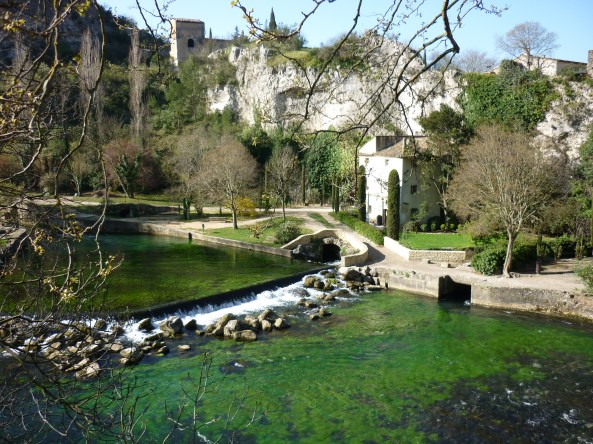
The Petrarch Museum in the white building on the right is believed to be on the site of Petrarch’s house.
This year I found myself talking about one place whenever anyone asked us about our trip to France. Sure, Nice was nice. Yes, Avignon was intriguing. Paris was bustling and full of things to see. The star of our visit was a small village that most people have never heard of.
Somewhere around 1310 Francesco Petrarca, his father and his brother made a visit to the source of the Sorgue River. It had been known for centuries as a miracle of nature. There was a hole at the bottom of a limestone cliff, a still pool, and then a raging river. Greeks and Romans had come to marvel at it in their time. Petrarca was a boy, but he declared that this was a place he wanted to live. Some twenty years later, he bought property and spent fifteen contented years off and on living in his house on the banks of the Sorgue, trying to forget Laure, writing, and tending his books and his gardens: one at his house and another by the still pool of the spring at Fontaine de Vaucluse.
There is a magic in this place. The incongruity of the stillness and the noise. The contrast of the white cliffs and greenery. The fortress on the top of the hill that was in ruins even in Petrarca’s time. The sound of the newly born river which seems to burrow into your head and erase all hurry. The meditative nature of the place.
I could never have described it from the photographs. This is one place that one has to visit to fully appreciate. I wish I’d had more time to just soak in the atmosphere of the place.
At the Petrarch Museum, located on the site of his house, I found a comment he’d made that in the past, people had come to Fontaine de Vaucluse to see the miracle of the spring, but in the future, they’d come because he had lived there. I pointed out to my husband the enormous conceit of a man to make such an assertion. He just smirked and said, “We’re here, aren’t we?”
And so we were. If Francesco Petrarca had not been writing about Fontaine de Vaucluse in the 14th century, I would never have known about it and I would never have sought the experience. I would never have found myself sitting by the river bank as the sound of the Sorgue carried me back seven centuries. He was pompous, but he was right. His words are entwined in the magic of the place.





 Shawn L. Bird
Flavia rocks! June 4, 2011
Tags: alan bradley, flavia de luce, postaday2011, Red herring without mustard, Sweetness at the bottom of the pie, Weed that strings the hangman's bag
I have just finished reading A Red Herring Without Mustard by Alan Bradley. This is his third book featuring 12 year old chemist Flavia de Luce. The other two are Sweetness at the Bottom of the Pie and The Weed that Strings the Hangman’s Bag.
What’s great about Flavia, is that although she is an uncommon genius in the chemistry lab, she has all the same issues that any youngest of three kids could expect- torturing by older siblings, being ignored by a distracted parent, etc.
Her bike, Gladys, is as much a character as Fatima the VW Beetle is in Grace Awakening. I like that someone else feels transportation can be a valid character. lol
Although Flavia is 12, these are not books for kids. The murders Flavia solves are rather gruesome. Nonetheless, the humour of her prepubescent attitude adds a lot of amusement to the stories. They are set in Georgian England. Flavia has a good relationship with their gardener who was a shellshocked WW I soldier and with their housekeeper Mrs. Mullet. Her mother Harriet was lost and presumed dead while mountain climbing. Her sisters are Daphne and Ophelia. They have their own unique talents. Their father has never gotten over the death of his wife, and has retreated into a world of philately.
Here is a little taste of Flavia’s voice:
How can you resist a character with so strong a voice? Even when the story goes just where you expect, Flavia is always a delightful surprise and there is always something interesting to learn!
Share this: