Shawn L. Bird

Original poetry, commentary, and fiction. All copyrights reserved.

The Exchange Student Cycle July 22, 2010

Filed under: Commentary,Rotary — Shawn L. Bird @ 7:37 am
Tags: , , , ,

Canadian Rotary exchange students at Helsinki World Figureskating Championships 1983 (+1 Aussie)

A couple decades ago, when I was working as an exchange student counselor, I came across some information about the exchange student cycle. It was such an accurate description that I have always made a point to tell exchange students about this cycle, because it is good to be warned of the bumps ahead.  If you know what to expect, when you’re in a rough spot, you can think of it rationally, knowing that soon enough you’ll move into the next part of the cycle. Everything has a season. These are the seasons of exchange student life.

It doesn’t seem to matter whether you’re involved in a two week exchange, a three month exchange, or a year long exchange; the cycle remains pretty much the same. An exchange is divided into three sections.  Each section seems to last roughly one third of the exchange.  Knowing the three parts to the exchange cycle helps you understand the changes in relationships and attitudes that occur throughout the year. If you imagine a typical ten month exchange in which a student arrives in the new country in late August and is set to return home around the end of June, the cycles will be split somewhere around November and March. There is no specific line, and you may find yourself moving back and forth between two stages for a month or two. If you rotate to a new host family every ten weeks or so, you will likely experience mini exchange student cycles in each home, as well as the over-riding year cycle.

During the honeymoon phase of the exchange, everything is new and wonderful. While sometimes there is an issue of culture shock, the student is usually expecting so much change that it isn’t too difficult to accept.  You’ve been warned that everything will be new and different.  You’re prepared for these differences and you’re excited to experience them. In this phase, the host family is still treating the student as a guest, showing them the sites and being solicitous. The school might be particularly challenging because of language issues, but you often feel like a celebrity, and are often treated as such. You tend to be on your best behaviour making an effort to be liked and interested in the new culture.  You tend to love your new culture a lot in this stage.

In the second phase, the bloom is off the rose. The family is used to having the student in the home. At this time, if there are host brothers and sisters, it is more likely that there will be some ‘sibling rivalry’ than at other times in the exchange. The novelty of the new experiences has worn off, and now the real work has begun. This is the point in the exchange when your new culture is a pain in the butt.  You long for your favourite meal, your favourite snack.  You want your friends.  You want your old, easy life. There is more expectation for you to be functioning in the new language, which can be stressful. School seems difficult and unaccommodating. In a year long exchange, this phase tends to coincide with Christmas time, which adds another challenge. You’re used to certain weather, special family traditions and foods, etc, but now you’re in a new place where the traditions are completely different, if they celebrate the holiday at all.  It’s not better or worse, it’s just different, but at Christmas time we often don’t want different, so it is not unexpected that you should be a little nostalgic for home and family. This is the period in the exchange where it feels like work. You let your best behaviour lapse and let your warts show up.  At this stage, petty irritations start to become issues.   This might be the point in the change when you want to give up and go home.  Hang on.  Keep trying,  talk to your counselor, and wait it out.  Luckily, at some point the challenge of this stage lifts, and one day you relax into life in your new culture.  You just fit comfortably into school and family.  You feel settled. 

Suddenly you realize that the exchange time is moving on, and that it is not going to be long before you are heading home. Now there is a last minute rush to do all the things you wanted to do. Now is when the student starts to enjoy every possible activity, because it might be the last opportunity to do it. There is a clear awareness that you have become at home in this new culture, and that it would not be difficult to stay here forever. In the third phase everything is bittersweet. Experiences are grabbed and savoured, but with the understanding of your attachment to this world, there is a sense of impending loss. The last few weeks of the exchange can be extremely difficult, as the worst part of being an exchange student becomes clear, but we’ll discuss that in another blog.

Be prepared for the changes and celebrate the victories!   You are experiencing one of the most challenging, most valuable, and most amazing year of your life.  Enjoy each phase.


coulda-shoulda-woulda July 20, 2010

Filed under: Poetry,Writing — Shawn L. Bird @ 8:19 pm
Tags:

I wished I could.
I thought I should.
then knew I would.

Though doubts amid,

I slipped and slid
fought could, should, would,
and then I DID.

.

.

This is the story of the birth of my writing career, synthesized.  Years of wishing and dreaming, slowly coming to believe that I could, and then finally actually writing the novel I’d wanted to write for thirty years.  The story was desperate to see the light, and when  I got down to it, it poured out at 25 pages a week.  Six months later I had a 150,000 word novel.  Astonishing.  When Grace Awakening hits the bookstore shelves September 2011, it will have been less than 3 years from the time I wrote the first words.  Wow.

If you dream of being a writer.  Quit dreaming.  Get writing.

.End of rant.       

.                  

Now to a poetry lecture:

The ‘eye rhyme’ is interesting here. 

Dipthong ‘ou’ makes 5 different sounds in this short 28 syllable poem, and ‘ough’ appears in every second line, teasing the eye into perceiving rhyme where there isn’t.


screams in the night July 19, 2010

Filed under: Poetry — Shawn L. Bird @ 12:08 am
Tags: ,

Beware the deadly hedgehog with its armour on its back

It is sneaking through the linens preparing to attack

Though you may slam the door on it, it’s coming through the wall

Although it’s very tiny, there is no hope left at all.

You will die a gruesome death, my friend, unless you show your fright

Your screams will echo loudly  ’til you defeat it with the light!

.

My husband has the craziest dreams.  The other night he woke up screaming, so I  asked what had happened in the dream. Ya ha.  Armoured hedgehog attack.  No kidding.  I’m still laughing!


our cat poodle July 18, 2010

Filed under: poodles — Shawn L. Bird @ 12:02 am
Tags: , ,

Meet Dusty.

Dusty is not an incorrigible counter surfer.  He is not a pantry raider with a death wish.  He is not a giant cream goofus.

Dusty is a cat.

Oh, I know.  From the photo he looks like a dog.  I’m sure his canine parents and his breeder thought he was a dog.  I’m sure when I’m walking him down the street on a leash that people think he’s a dog.

It’s a lie.

Dogs are adoring.  They follow their masters and want to be picked up.  They come when they’re called.  They’re cuddly and happy.

Not cats.  Cats climb to the highest points of sofas.  They refuse to be picked up.  They ignore you if you want their attention.  They have their own agenda.  They force you to do what they want.  They take off and don’t come when you call them.

That’s Dusty. 

Well.  That’s Dusty most of the time.  He does have one canine habit.  It’s a good thing he does, because it is the secret to controlling him.  Dusty has what we call BOD.  Ball Obsession Disorder.  We can get him to do almost anything if we produce a ball as bait.  He has a very impressive repertoire of tricks that he will do if you will throw a ball after he does what you ask. 

Sometimes BOD saves his life.  Every couple of years Dusty managed to break out of the house and took off running.  The only fool proof way we discovered to get him back was with a ball.  While he is tearing down the sidewalk at full speed, a ball thrown past him will exert a powerful force.  You can watch the magic power break through his desire for freedom as he swerves helplessly to follow the ball.

He grabs it, and then he must return it.  He needs it to be thrown again.  He’ll drop it on the sidewalk  just out of reach so you can’t grab him, but now you have him anyway.  You throw toward the  house, in successive throws and returns until you’re throwing it through the front door, and he is compelled  to follow it in.  Shut the door and he wags his tail as he takes his ball and collapses on his pillow. 

Then he curls up and becomes a cat again.


love love love July 17, 2010

Filed under: Grace Awakening,Pondering — Shawn L. Bird @ 12:19 am
Tags: ,

From Grace Awakening

Bright to Grace about Jim:

“He is everything I need and I’m better in all ways because of him”

Bright’s not the only one who knows how blessed she is. 

 I was recently asked the secret to a long marriage.  It’s quite simple, really:  Stay married. 

When things are difficult, stick them out.  When you’re angry, talk it out.  Even when you want to, don’t walk out. 

Celebrate every joy.  Appreciate all the little things. 

Happy 25th Anniversary, my love. 

Aren’t you glad that I’m still the same age I was at the wedding?


bad talents (part 5) July 16, 2010

Continued misadventures of Kimelle’s Optimum Jive aka OJ the standard poodle  

The (first) Near Death Experience.  

True and very scary story.  However, like most true and scary stories, it has its comical elements.  So while we’re laughing about this, I know we are all very aware of how very, very close this was to being a tragedy.   Consider this a cautionary tale.

I tend to have the TV on, my notebook computer out, and be reading  (or writing) a book well into the wee hours of the morning.  The dogs (OJ and Dusty, his mini-poo brother who is much less prone to life threatening idiocy) fall asleep on a couch or their pillows, keeping me company until lock them up for the night when I finally head off to bed.  One night, I fell asleep on the couch around 2 a.m. and woke up again at 4 a.m.  I staggered down the hall to lock up the dogs in their room, and crashed on my bed.  At 8 a.m. I was attacked by a flying poodle.  

Normally, my husband wakes up first, gets the dogs up, outside and serves them breakfast.  Then he locks the two of them in the bedroom with me when he heads off to work.  (We endeavour to keep the dogs contained when we aren’t supervising them, for obvious reasons).  I am usually awakened by my radio blaring, and open my eyes to find OJ’s nose nearby or Dusty dropping a stinky ball beside my head.  Apparently on the day in question, our containment routine was missed.  Hubby had neglected to shut the dogs in with me; I guess because he was home and puttering around in the basement and garage.  

I blinked sleepily as OJ barked a happy bark next to my face, wagging his tail furiously, and then he leapt off the bed and tore off full speed down the hall.  I tried to wake up, but didn’t rise.  OJ came tearing back up the hall, leapt onto the bed with a long, gazelle-like stride, his front feet landing firmly on my belly.  As I struggled to regain my breath, OJ stood next to me, tail creating an impressive breeze, while he panted like he was laughing at me.  I sat up.  He barked again and raced off down the hall again.  Before I had my feet on the floor he had roared back up the hall and was beside me on the bed panting again.  OJ is not a morning creature either.  He is generally the last body out of the bed everyday.

“Do you have to go out, OJ?”  

“WOOF!” he declared and raced off again.  

“All right, all right.  I’m coming,”  I muttered as I stumbled down the hall and let him into the back yard.  He tore out the door and raced several circuits of the yard.  I stood at the kitchen window watching.  OJ is not a very energetic dog.  This was very odd behaviour.  He stopped at his favourite tree and lifted his leg.  He promptly fell over.  It took him a couple of tries to get his tri-pod balance and get the job done.  This was weird.  

I met him at the door to let him in.  He raced into the living room, leapt up onto the couch, and promptly fell off.  This was alarming.  I went to the couch and he jumped up beside me.  I felt into his arm pit* for his pulse.  His heart was racing.  I felt his feet.  They were really hot, almost sweaty feeling. I pushed a finger onto his gum.  It stayed white longer than it should. **  What on Earth was going on?  I ordered him to a pillow to lay down.  He obeyed, then stood again panting.  I ordered him down again.  He obeyed, then stood again.  He couldn’t contain his energy.  

I went into the kitchen and started making myself some pancakes while I thought about what to do.  OJ followed me.  He stumbled as he walked. His eyes were unnaturally bright.  

I opened my pantry door to get some flour and the mystery was solved.  

Pulled through the wires of one of the pantry drawers was the wrapping from a chocolate bar. A large chocolate bar.  I turned to OJ in horror.  “OH NO!”  He looked down at the floor, giving his tail a weak, decidedly guilty wag.   

Crap.  Crap. Crap.  This was bad.   

This was very, very bad.   

Science lesson:  

Dogs cannot eat chocolate.  It’s not so much the caffeine as it is a related chemical called theobromine found in the cacao bean that is seriously toxic to their system.   Theobromine levels increase the darker the chocolate.  White chocolate has hardly any.  Milk chocolate has some.  Bakers chocolate has tons.  According to talktothevet.com the toxic level of 100 mg of theobromine per one kilo of canine body weight works out like this:  

1 ounce per 1 pound of body weight for Milk chocolate
1 ounce per 3 pounds of body weight for Semisweet chocolate
1 ounce per 9 pounds of body weight for Baker’s chocolate.  

OJ had consumed almost all of a huge bar, about 10 ounces of 80% cacao specialty chocolate (i.e. Bakers).  He weighs 65 lbs.  He was well over the toxic threshold of about 7.3 ounces for his body weight.  He was looking death in the eye.  

We phoned the vet to tell them we were coming.  We were in the examining room 10 minutes later.  As usual, OJ behaved like a model citizen in the vet office.  He believes strongly in his role as standard poodle ambassador, even when at death’s door.  He allowed the vet to poke and prod without complaint, even when his tail was lifted and the thermometer was inserted.  He gave me a rather unimpressed look while the vet talked to him and tried to distract him from indignity by patting at the other end, but OJ bore it all.  His temperature had come down; I could feel it in his paws as well.  The vet took his pulse, and his heart rate was just a bit above normal.  His blood pressure was almost back to normal.  The verdict was that he had already passed through the danger zone, and was in recovery.   

Once a dog has reached the stumbling stage, the brain is suffering from the toxicity.  After that stage come seizures, and then heart or respiratory failure.  OJ had ingested enough theobromine that he should have died.  I was sent home and told to bring him back if he developed seizures, but the vet was pretty sure he was going to be fine.  The good news for us was that although theobromine takes several days to clear out of the system, it doesn’t leave lingering effects, such that a few chocolate chips at a later date would tip the scales and kill him.  He gets to start from zero again.  Considering OJ’s incorrigibility, this is a very good thing.  

Ever notice how OJ is sleeping in all his photos? He's really just faking, while he plans his next stealth mission of death.

We had no idea when OJ got into the chocolate.  It could have been while I was sleeping on the couch or when he was left out after starting his day.  It takes a few hours for the effects to show. If we had caught it early enough, he could have been given charcoal to absorb it or had vomiting induced to get the theobromine out of his system before he was poisoned.  Because we figured it out only after we observed the neurological symptoms, it was too late to do anything except treat him with anti-convulsants if he developed seizures, which luckily, he didn’t.  

 Needless to say, I no longer store my chocolate in the pantry.

* find your dog’s pulse using the femoral artery in the ‘arm pit’ of a back leg, palm facing the leg.

** you can check for blood pressure by pushing the gums.  Do it when the dog is healthy to see how quickly the spot goes from white to normal again.  (about a second).  If it takes 2 or 3 seconds, the blood pressure has dropped.


Bad talents (part 4) July 15, 2010

Filed under: poodles — Shawn L. Bird @ 12:00 am
Tags: , , , ,

Further misadventures of Kimelle’s Optimum Jive aka OJ the standard poodle.

OJ loves packages.  He loves zip-locked bags.  Apparently opening a zip lock bag for him is like opening Christmas presents to a four year old.  He doesn’t care what is inside the bags, it’s the opening that he likes.  50 little bags on a ring, each neatly labeled and stuffed with entirely inedible little circular Girl Guide badges?  Oh those are a wonderful prize.  He happily opened every single bag and scattered a couple hundred little badges all over the family room, so I would have the pleasure of sorting them all again.  He’s helpful that way.

How about those expensive, heavy duty ziplock bags made for miniature toiletries while travelling through customs?  Even empty, because of their deluxe nature I suppose, opening them brings him joy.  He is careful to ensure all our toiletry bags have adequate drainage and ventilation.

If, however, the bags happen to contain food, OJ is in paradise.  He routinely opens up my purse to check for treats.  He can open zippers on the purse, and on the cosmetic bag within.  (I prefer this to the times before he bothered to open zippers when he’d chew through several layers of lining ).  He likes those little foil packages of hand-wipes.  He doesn’t eat them, but he likes to open them.  I presume that’s more about ventilation.   He has eaten countess granola bars stored in my purse for emergency snack.  (Mine, not his).  Yeah, yeah.  I should put my purse up where he can’t get it.  I know.  He’s sneaky.  He distracts me.  He pretends he’s not interested, and then wham- purse raid.

He showed amazing skill opening little packages of sesame seed snaps last year.  I came across a good dozen empty wrappers in a tidy pile beside their box between his pillow and the couch.  He’d managed to smuggle the box out of the pantry and individually opened each package before devouring the treats within.   You wouldn’t find many dogs taking the time to do that, but poodles have class.

We took him to the vet after that one, actually.  He looked a little green when I found him.    The x-ray showed his lower digestive tract was rather packed with seeds, but with a little  time tidy tubes of sesame seeds were duly deposited in the back yard.  They didn’t attract nearly as much attention as the pile of raisins and dried cranberries I’d cleaned up the year before.   Ants love fruit that has traveled through a dog digestive tract, apparently.

I do live in fear that OJ will commit suicide by stolen food.  It is far to easy to imagine.  He almost did it this year.  I’ll tell you about that tomorrow.


How to have an amazing Rotary Youth Exchange year July 14, 2010

Filed under: Rotary — Shawn L. Bird @ 5:45 am
Tags: , , , , ,

Today I got an email from an outbound exchange student in response to my blog “Why I am a Rotarian.”  I started to write some hints for Chris, but then thought perhaps they’re best recorded as whole blog entry rather than a comment.  So here is a message dedicated to Chris who is on the way to India, and any other outbound Rotary Exchange Student.   

Rotary Youth Exchange will be a life changing experience, but how successful your year is completely rests upon your shoulders.  You need to approach your exchange with an attitude of openness.  You have to be willing to try new things, whether it’s new clothes like a burka or school uniform, new food like liver casserole or goats’ eyes, or new experiences like attending a different place of worship  or participating in inexplicable festivals.  This is a cultural exchange and your job as an exchange student is much more that representing your culture.  It is even more important that you learn as much as you can about your host culture so that when you return home, you can reflect a new view of the world to your home community.  This year will impact the rest of your life.   

So here is some advice from me from my rather broad perspective as a returned exchange student, a host mom, an exchange counselor, the mother of an exchange student , a Rotarian and a high school teacher.  I hope these suggestions will help you approach the most difficult year of your life with enthusiasm so that in embracing the challenges, you find yourself becoming a global citizen.   

embrace cultural practices- like Finnish sauna

1. Adjust your attitude.  Whenever you are faced with a cultural challenge, remember it’s not better, it’s not worse, it’s just different! We don’t all have to be the same on this planet; diversity brings beauty in the world.  Embrace it all.  Be open to the new.  Avoid saying, “At home we do it like this…”  Say, “That’s interesting.  Can you tell me more about that?”  Listen.  Learn.  Keep your better/worse thoughts in your private journal.   A lot of brilliant A students struggle as exchange students.  They’re used to being the best in the class.  They don’t like to make mistakes.  They expect excellence in themselves.  Let it go.  You are not in your perfect world any more.  There are new rules on exchange.  Relax.  Let yourself make mistakes so you are free to learn.  Embrace the novelty of not being the best.  Just be.   

2. Learn the language of your area as soon as possible. Speak it often.  Take special classes if necessary.  Everyone will want to speak to you in English, don’t fall into the trap. If you’re in Barcelona, the area language is Catalan, not Spanish.  What is the language or dialect of your region? Make that your focus.  Language is the gate to culture, and you want to open that gate.  If you don’t learn the language, you will miss significant understanding of your hosts and your host culture.  Even if you do it badly, the effort to learn the language is crucial to your host community seeing that you are committed to learning about them.  Go beyond Hello, Good-bye, Please and Thank You.  Be willing to make mistakes and be laughed at for your mistakes.  Join into the laughter, learn the correct way, keep talking.  Especially learn the words that have no English translations, because those words represent important cultural concepts.   

Finnish Independence Day parade

3. Take every opportunity you can. Go wherever you can.  You will frequently be invited somewhere, and you won’t have a clue what it is.  Go anyway.  Take your camera.  Prepare to be amazed.   

4.  Get involved with your sponsor Rotary Club.  Sometimes you have to work hard to do this, because overseas clubs often don’t involve their exchange students.  Be sure the club knows you want to help with their service projects.  Go to meetings at least once a month.  Pester them to involve you if you must.  Yes, the business component is boring, but use the social time to meet members.  Find out what they do, express curiousity.  You may get invited to join them on a ski trip or a reindeer round up.  You never know.  Rotarians are amazing community leaders with fascinating experiences.  They have a lot to teach you.  Ask questions.  Learn.   


 5.  Don’t be shy. Don’t wait for others to approach you.  Make the first move.  You’re going to be gone in a year and so some people won’t want to make the effort to be your friend.  They might become your best friend if you make the first move.  Say something like, “Excuse me, I’m an exchange student, can you explain this…?”  Ask questions.  Be curious.  Smile.   Your closest friends are quite likely going to be other exchange students or former exchange students.  This is a comfortable thing, because you have the most in common with them.  You can rely on them to help process the cultural challenges, but beware of pity parties and grumbling.  Don’t let exchange students be your only friends; the more friends you have from your host culture, the more experiences and opportunities you will have.   

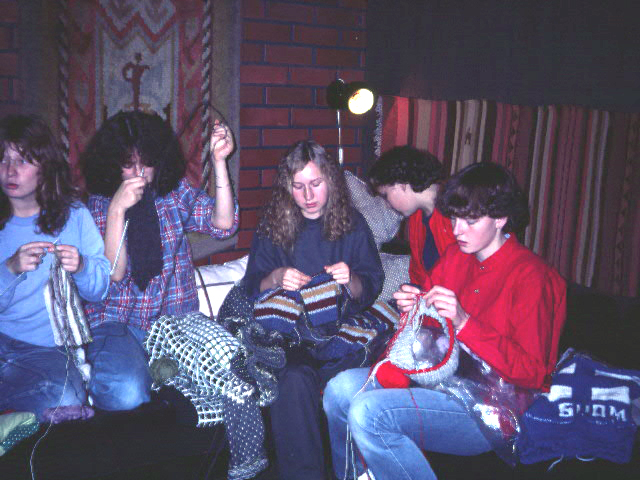
a knitting party with Finnish teens

6. This might be the most important point, especially in this age of instant communication around the world. Let go of home. Certainly, post a weekly log of your activities to share your experiences with your friends and family back home, that’s an important reason you went on exchange.  Keeping a journal provides a record of what you learn and gives you a tool to reflect upon for the rest of your life.  However, daily writing with your girl/boyfriend back home, trying to negotiate your best friend’s break up or panicking about your college entrance means your focus is back home instead of on your cultural immersion.  You’ll need to contact home now and then so your mother doesn’t go crazy, but your focus must be on your new culture.  You’re never going to have this exchange opportunity again.  Don’t waste it! Embrace your new culture and let go of home.  Your home culture will still be there at the end of your exchange year.   

Have an absolutely amazing, fascinating, life changing Rotary Exchange!


Bad talents (Part 3)

Further Misadventures of Kimelle’s Optimum Jive aka OJ the standard poodle.

As previously mentioned, counter-surfing requires stealth, balance, and ingenuity. OJ leaves us baffled on a regular basis. We have no idea how he does the things he does. I have heard it said that poodles are so intelligent that they are frequently the ones who train their owners. The dog books say unintelligent people should probably avoid owning poodles. My husband and I have university degrees and respectable IQs. You’d think we’d be able to keep up with a dog.

.
OJ loves soup. His favorite is Campbell’s Butternut squash soup. This is how I know.

.
Last year there was a sale on Campbell Gardennay soups. I had considered purchasing them several times in the past, but had thought they were too expensive. At three for six dollars, I was finally willing to try them. I purchased three different soups: Summer Asparagus with Sweet Basil, Fire Roasted Red Pepper and Tomato, and Butternut Squash. I put the three tetra-bricks into my pantry on the pullout wire drawer. I already had two generic soups in tetra bricks in that drawer and I added the three Gardennay soups behind them. I was particularly keen to try the Butternut squash, since that’s my favorite Tim Hortons soup.

.
A couple days later, I came into the living room to discover a strange silver rectangle on the living room floor. It looked like a chunk of metal. What was it? I leaned over to investigate. OJ jumped off the couch and sauntered nonchalantly down the hall.

.
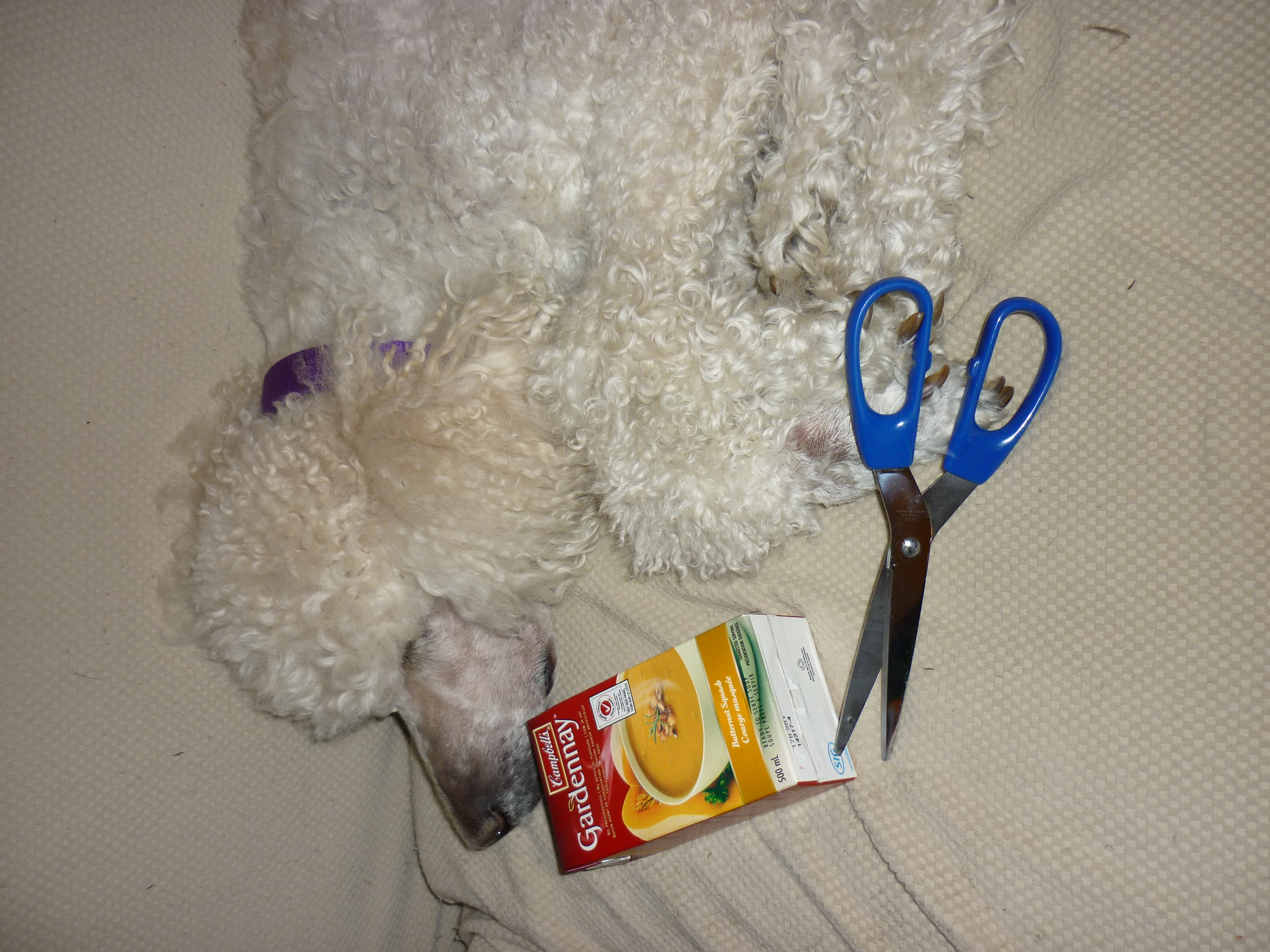
I picked up the weird silver thing and turned it over to study it with confusion. Formerly it had been a Gardennay tetra-brick. Now it was a perfectly flat, absolutely clean silver rectangle. There were no chew marks. You would swear he’d taken a pair of scissors and cut the box open down the seams. There was no soup anywhere. Floors, couch and dog pillow were all clean. Of course it was my Butternut Squash soup. Damn freakishly talented counter-surfing dog.

.
I went out shopping later, and bought another three soups.  This time I bought two Butternut Squash boxes, muttering at OJ the whole time. At home, I tucked the soups in the pantry, setting the two Butternut Squash boxes at the very back of the drawer. Whoever took this soup out was going to have to pull out the drawer. OJ can’t open the door to the pantry, thank heavens. He can’t pull out the drawer. I cooked up a pot of  Butternut Squash the next day.  It was excellent.  I ate it all, and did not leave the pot unattended. I savoured the idea of the second box waiting for another day.  OJ lay covertly on the couch, plotting while he pretended to be sleeping.

.
It wasn’t even a week later that I walked into the living room to see a familiar silver rectangle sitting reverently on a dog pillow. The pantry drawer was closed. I pulled out the drawer. The soups were all present and accounted for. All but one.

.
Some people have drug sniffing dogs. Some people even have cancer sniffing dogs. I have a Campbell Butternut Squash Soup sniffing dog—-that can apparently use scissors.

He’s also good with other fastenings, as you will read.


bad talents (Part 2) July 13, 2010

The continued misadventures of Kimelle’s Optimum Jive aka OJ the standard poodle.

As I was saying in the last entry, skillful counter surfing requires stealth, balance and  ingenuity.  OJ’s ability to balance objects is particularly impressive, especially when one considers that he has to do it without opposable thumbs.  He’s not even a particularly huge standard, either, reaching only 25 inches at the withers, so he can’t use height to much advantage. Yet, it is not uncommon that I should wander down the hallway and discover a now clean frying pan nestled artistically in the centre of a dog pillow.  I’ve never caught him at it, so I’m not sure how exactly he manages to remove the pan from the stove and get it into the living room without dropping it on the floor.  Talented dog, indeed.

The best example of OJ’s remarkable balancing skill came on a day that I’d made myself tomato soup and a grilled cheese sandwich for lunch.  I made up the can of soup (artfully seasoned with garlic, oregano, basil, and parmesan) ate my lunch and then wandered off to do some chore.  I left half the soup in the pot on the stove for a second helping later.

.

Tomato soup.

.

Did I mention my living room couch is white?

.

I went into the kitchen for another bowl of soup.  I went to the stove and looked around blankly. The pot was missing.  I was the only human at home.  I went hunting.  I came around the corner saw something  suspicious twinkling in light.  I stepped closer in amazement.  You’re imagining my couch looked like a scene of carnage from a horror movie, aren’t you? You’re imagining it appeared as if a murder had been committed at the stove and the hapless victim was dragged, thrashing in agony, splattering red all the way to the couch where he’d been finished off in some gruesome throat ripping way, right?   Yeah.  So was I.

Well, we were both wrong.  All that greeted me in the living room  was a spotlessly clean soup pot glistening in the middle of my still pristine white fabric couch.  There was not a drop of tomato soup to be seen anywhere.  Not in the kitchen.  Not in the hall.  Not in the living room.  How on earth did he manage it?  Your guess is as good as mine.  Like I keep telling you.  He’s a talented boy.

.

Really, I just need to figure out how to train this dog to return the scrubbed pots and pans into the sink.

.

.

.

PS.  OJ wishes you to know that  he posed today for the accompanying photo under duress, simply for illustrative purposes.  He asserts that he has absolutely no knowledge of any empty tomato soup pots alledgedly found on the living room couch .

OJ likes tomato soup, but his favourite is butternut squash, as you’ll see here.