

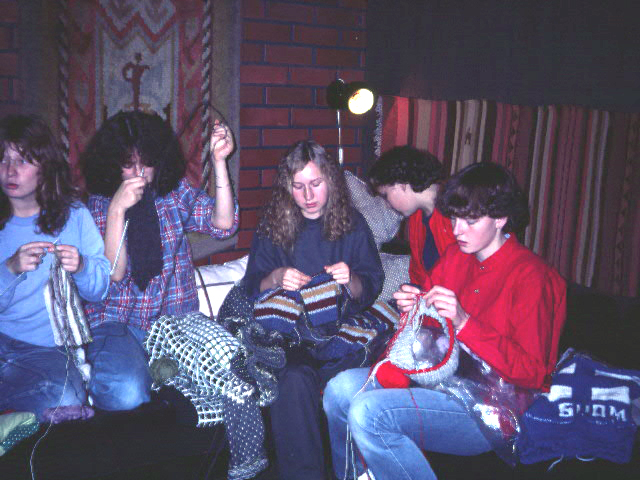
Canadian Rotary exchange students at Helsinki World Figureskating Championships 1983 (+1 Aussie)
A couple decades ago, when I was working as an exchange student counselor, I came across some information about the exchange student cycle. It was such an accurate description that I have always made a point to tell exchange students about this cycle, because it is good to be warned of the bumps ahead. If you know what to expect, when you’re in a rough spot, you can think of it rationally, knowing that soon enough you’ll move into the next part of the cycle. Everything has a season. These are the seasons of exchange student life.
It doesn’t seem to matter whether you’re involved in a two week exchange, a three month exchange, or a year long exchange; the cycle remains pretty much the same. An exchange is divided into three sections. Each section seems to last roughly one third of the exchange. Knowing the three parts to the exchange cycle helps you understand the changes in relationships and attitudes that occur throughout the year. If you imagine a typical ten month exchange in which a student arrives in the new country in late August and is set to return home around the end of June, the cycles will be split somewhere around November and March. There is no specific line, and you may find yourself moving back and forth between two stages for a month or two. If you rotate to a new host family every ten weeks or so, you will likely experience mini exchange student cycles in each home, as well as the over-riding year cycle.
During the honeymoon phase of the exchange, everything is new and wonderful. While sometimes there is an issue of culture shock, the student is usually expecting so much change that it isn’t too difficult to accept. You’ve been warned that everything will be new and different. You’re prepared for these differences and you’re excited to experience them. In this phase, the host family is still treating the student as a guest, showing them the sites and being solicitous. The school might be particularly challenging because of language issues, but you often feel like a celebrity, and are often treated as such. You tend to be on your best behaviour making an effort to be liked and interested in the new culture. You tend to love your new culture a lot in this stage.
In the second phase, the bloom is off the rose. The family is used to having the student in the home. At this time, if there are host brothers and sisters, it is more likely that there will be some ‘sibling rivalry’ than at other times in the exchange. The novelty of the new experiences has worn off, and now the real work has begun. This is the point in the exchange when your new culture is a pain in the butt. You long for your favourite meal, your favourite snack. You want your friends. You want your old, easy life. There is more expectation for you to be functioning in the new language, which can be stressful. School seems difficult and unaccommodating. In a year long exchange, this phase tends to coincide with Christmas time, which adds another challenge. You’re used to certain weather, special family traditions and foods, etc, but now you’re in a new place where the traditions are completely different, if they celebrate the holiday at all. It’s not better or worse, it’s just different, but at Christmas time we often don’t want different, so it is not unexpected that you should be a little nostalgic for home and family. This is the period in the exchange where it feels like work. You let your best behaviour lapse and let your warts show up. At this stage, petty irritations start to become issues. This might be the point in the change when you want to give up and go home. Hang on. Keep trying, talk to your counselor, and wait it out. Luckily, at some point the challenge of this stage lifts, and one day you relax into life in your new culture. You just fit comfortably into school and family. You feel settled.
Suddenly you realize that the exchange time is moving on, and that it is not going to be long before you are heading home. Now there is a last minute rush to do all the things you wanted to do. Now is when the student starts to enjoy every possible activity, because it might be the last opportunity to do it. There is a clear awareness that you have become at home in this new culture, and that it would not be difficult to stay here forever. In the third phase everything is bittersweet. Experiences are grabbed and savoured, but with the understanding of your attachment to this world, there is a sense of impending loss. The last few weeks of the exchange can be extremely difficult, as the worst part of being an exchange student becomes clear, but we’ll discuss that in another blog.
Be prepared for the changes and celebrate the victories! You are experiencing one of the most challenging, most valuable, and most amazing year of your life. Enjoy each phase.








 Shawn L. Bird
Rotary Youth Exchange: open mind, broken heart July 27, 2010
Tags: exchange student, Rotary, Rotary Youth Exchange, study abroad, youth exchange
In the blog about The Exchange Student Cycle, I mentioned that at the end of an exchange, the worst part of being an exchange student becomes clear. No one warns you about how difficult it is to come home.
When you choose to be an exchange student, you know in your head that you are going to become attached to your new country. You know that you will have host families and that you will make friends abroad. You hope they will be close friends. You hope you will love your families. Friends and families provide the strength and value of an exchange, but they also cause the greatest pain. When you leave home, you expect to see all your friends and families in a year, but when it comes time to leave your new country, you realize that you may never see these people again. They have become a precious part of your life, and you are leaving them behind to return to your old life. If you have had the wonderful year you wanted to have, you are about to be disemboweled. Unless you’ve experienced the death of a loved one, it is unlikely you will ever have experienced the suffering you will endure when you leave your exchange friends and families behind to return to your old life. You can never return to your exchange life. Even if you return to the country, it will never be the same again.
If you’ve had a successful exchange year, you will have embraced a new life. You will feel part of a new culture. You’ll be dreaming in a new language. You will feel like you belong in that world, and the life you left at home will seem very, very far away. You will wonder that you ever found it strange and difficult to fit in. You will find it difficult to remember what life was really like back home, and that’s the moment when they send you home.
Now the crushing truth becomes clear. You are leaving people you love behind, and you may never see them again. The pain is engulfing. Your heart is about to be torn in half, and left behind in your exchange country. When your heart is left behind, the exchange was everything it was supposed to be.
Rotary Youth Exchange: opening minds and breaking hearts since 1929.
Share this: