Shawn L. Bird

Original poetry, commentary, and fiction. All copyrights reserved.

A Newbie’s Guide to Publishing: What Works: Promo for Ebooks June 27, 2011

Filed under: Commentary,Writing — Shawn L. Bird @ 12:50 am
Tags: , , , ,

A Newbie’s Guide to Publishing: What Works: Promo for Ebooks.

Here is a fascinating  and thorough examination of promotion strategies and ebook publication by Joe Konrath

Konrath’s blog is well worth reading by anyone interested in writing or publication.  It is full of tips and interesting articles.  You could spend a lot of time wandering through here, and I suggest you do!

I was reading on Smashword.com today that Amazon is getting 1000 new e-titles a week.  52,000 e-book titles a year.  Wow.  Having your book stand out in that kind of crowd is going to take a bit of effort.  We need all the help we can get!


Amanda Hocking June 21, 2011

Filed under: Writing — Shawn L. Bird @ 12:34 am
Tags: , , ,

How do I know that I am Canadian?  Every time I go to write the name of young e-book millionaire Amanda Hocking, I start by writing “Hockey.”  Yeah.

.

Amanda Hocking is a success story.  She wasn’t being picked up by traditional publishers.  She believed she had a good product in her urban fantasy novels about trolls, and so she uploaded her first books onto smashword.com, an e-book store.  They started selling.  Obviously she had found a niche that appreciated her story telling ability and the fictional worlds she created.  She treats writing as a full time job.  She crafts her stories and writes with focus.  She writes fast as well, completing a book a month.   It’s prolific to have 10 books out in a year!  Since she uploaded her first urban fantasy novel spring of 2010, Amanda has received a million dollars in royalties on e-books that sell for 99c and $2.99.  The fact is, she gets to keep so much higher percentage, she has made more than she could using a traditional publisher.

So why use one?

Amanda is an example of how the publishing industry is changing.  Once upon time, traditional publishers were the only way to access the market, but now authors can upload their books to Amazon or other ebook purveyors, and they are instantly available to readers around the world.

Once upon a time, traditional publishers were the key way to promote and market your book, but now authors maintain their own websites, Twitter accounts and communicate directly with their readers.

In my contract with my traditional publisher, I was required to keep a website and arrange speaking dates.  When all was said and done, I was likely to see about $1 per book in royalties.  I will do all the same things dealing directly with my readers through my inde pub house, and I’ll be earning double that.  Hmm.  I think we’re onto something here.

♫ The times ♪ they are ♫ a-changing. ♪


the gentle art of the critique June 20, 2011

Filed under: Pondering,Writing — Shawn L. Bird @ 12:52 am
Tags: , ,

Or it my case, the brutal crush of the criticism.

I live in a world that requires critical evaluation. Every year I have my students complete a questionnaire about their year so I can use their feedback to become a better teacher the next year. I submit my literary babies to be studied by editors whose job is finding things I did badly. When I have a harp lesson, the teacher’s job is to tell me what are the weak areas in my playing. When I am taking a dance class, the teacher’s job is to point me out in the middle of class and say, “You’re not doing that move correctly”

In every aspect of my life, I expect to be offered helpful advice. In many cases I am paying good money to be told that I stink at something. What would be the point of doing any of these things if I didn’t want to get better at them? How could I get better at them without someone showing me exactly what I’m doing wrong?

This is why I don’t understand the people who ask for advice, but spend all their time arguing or denying when the suggestions are given.

I’ve been to Author Blue Pencils where the author critiquing my work spends more time telling me that I’m free to take or leave her suggestions than actually giving me practical advice.  Now I tell them straight out that I’m there to listen. Most recently, I tell them exactly what I want them to help me with.  e.g. “I think this area is weak, what suggestions can you make?” or “Is this exposition clear enough?”  They are always so relieved that I really want honesty and that I can ask intelligent questions to clarify what they’re telling me that I get great feedback. Even if I disagree with them, when I’ve heard their advice, I go home and look at the work and ponder. I almost always edit later taking their suggestions into account. People who are successful in your field will give you invaluable information, what kind of fool are you when you discount it?

I am okay with separating an action from my personal value. Because I don’t do a ‘half Amaya hip slide’ correctly, does not mean I’m stupid, incompetent, or bad. It means I need to spend some time working on that skill. That’s all.

Because I expect feedback and critiques in all areas of my life, I have trouble with people who get all defensive and argumentative when they are given advice. I tend to lay things out plainly and expect rational consideration.  I recognise that I have all the finesse of a blunt stick at times.  I don’t want to hear whining. I give my opinion. I just want them to consider what I am saying and how following my advice might improve their writing, business, or whatever.

So here is some advice for you: If someone offers you suggestions meant to help you, quit wasting your time complaining about the injustice of the comments or how the advisor is so mean to you and put your energy into thinking about the information they’ve given you. It doesn’t matter if you agree right away, but you have to start by accepting that there are other perspectives than your own and you have something to learn in studying other perspectives. If it is a professional comment, be professional in how your receive it.  Thank the client for telling you.  Many clients will simply smile, tell you things are great, but then they don’t return and they tell their friends what they didn’t like about your business.  Be very thankful for a client who helps you improve and grow.

No one who is successful in life runs from criticism.  It is the manna the feeds the improvements that they must build on.

Choose to be successful.


watch June 14, 2011

Filed under: Writing — Shawn L. Bird @ 5:25 pm
Tags: , ,

A paraphrased quote to ponder from Angie Abdou, from notes taken while she was presenting at the Shuswap Lake Writers’ Conference last month:

Be open to the story all around you.

There is a world of story in every moment

and it can be told a thousand ways.


ebooking history June 5, 2011

Filed under: Writing — Shawn L. Bird @ 7:17 pm
Tags: ,

One of the benefits of the e-book is that authors and publishers can easily re-release out of print books. The summer I turned thirteen, I read a book by a teen ager. I was so impressed that a young person had been published, and enjoyed the book so much, that I never forgot it. It was  The Green Bronze Mirror by Lynne Ellison.  It was a time travelling book of a girl who leaves modern England and finds herself in Roman times.

Over the years I kept my eyes open for it, but it wasn’t until this year that it showed up. It was available as a very inexpensive ebook download. Yeah! So now it’s in my e-reader and I have read it through a couple times, searching for all the components that captured my imagination as a kid.  Now I can see that there are some rough patches that a good edit could have improved, but I also see what I loved in it, as well.

How easy it is to re-release old books now that there are ebooks!

I just keep thinking e-books are the future, and perhaps it’s worth cutting through all the middle men to offer one’s book directly to the readers.  The more I hear, the more I am convinced that this is the right move.  I am working out the details, but it’s coming together for Grace Awakening to be released as an ebook later this summer.  It was always in the plan that Gumboot would release an electronic version.  It’s quite possible I maybe ready to release it even earlier than the scheduled Gumboot release.  Wouldn’t that be ironic?

Old books are easily re-released. New books are easily released. A good offering should find a readership.   With the right promotion, it should generate the movement it needs to find the readers who will love it.

And so it begins.

Before any great journey, the provisions must be prepared. The day of embarkation is within sight. When the tide is right, we will sail!


Flavia rocks! June 4, 2011

I have just finished reading A Red Herring Without Mustard by Alan Bradley.  This is his third book featuring 12 year old chemist Flavia de Luce.   The other two are Sweetness at the Bottom of the Pie and The Weed that Strings the Hangman’s Bag.

What’s great about Flavia, is that although she is an uncommon genius in the chemistry lab, she has all the same issues that any youngest of three kids could expect- torturing by older siblings, being ignored by a distracted parent, etc.

Her bike, Gladys, is as much a character as Fatima the VW Beetle is in Grace Awakening.  I  like that someone else feels transportation can be a valid character. lol

Although Flavia is 12, these are not books for kids.  The murders Flavia  solves are rather gruesome.  Nonetheless, the humour of her prepubescent attitude adds a lot of amusement to the stories. They are set in Georgian England.  Flavia has a good relationship with their gardener who was a shellshocked WW I soldier and with their housekeeper Mrs. Mullet.  Her mother Harriet was lost and presumed dead while mountain climbing.  Her sisters  are Daphne and Ophelia.  They have their own unique talents.  Their father has never gotten over the death of his wife, and has retreated into a world of philately.

Here is a little taste of Flavia’s voice:

My experience of cod-liver oil was vast.  Much of my life had been spent fleeing the oncoming Mrs. Mullet, who, with uncorked bottle and a spoon the size of a garden spade, pursued me up and down the corridors and staircases of Buckshaw–even in my dreams.

Who in their right mind would want to swallow something that looked like discarded engine oil and was squeezed out of fish livers that had been left to rot in the sun?  The stuff was used in the tannig of leather, and I couldn’t help wondering what it would do to one’s insides.

“Open up, dearie,” I could hear Mrs. Mullet calling as she trundled after me.  “It’s good for you.”

“No! No!”   I would shriek.  “No acid!  Please don’t make me drink acid!”

And it was true–I wasn’t just making this up.  I had analyzed the stuff in my laboratory and found it to contain a catague of acids, among them oleic, margaric, acetic, butyric, fellic, cholic, and phosphoric, to say nothing of the oxides, calcium and sodium.”

Alan Bradley.  A Red Herring without Mustard.  Toronto: Doubleday. 2011 (pp.127-8)

How can you resist a character with so strong a voice?  Even when the story goes just where you expect, Flavia is always a delightful surprise and there is always something interesting to learn!


story urge May 31, 2011

I’ve been reading a book called The ABC’s of Creative Nonfiction edited by Lee Gutkind. The theme is there is a compulsion to tell our stories that goes beyond cultural and is actually biological, he says,

The act of autobiography forms in our frontal cortices, while the will to write likely lies in the limbic system, one of the oldest parts of the brain, governing not only basic desires for food and sex but social bonding, learning, and memories. We are the most vocal of the primates, and sharing the intimate details of our lives has many functions: the act makes us feel connected to others, alleviates stress, and makes us healthier. Writing about emotionally laden events increases our T-cell growth and antibody response, lowers our heart rate, helps us lose weight, improves sleep, elevates our mood and can even reduce pain.
(Keep It Real. ed. Lee Gutkind. New York: Norton. 2008)

So. It’s not obsessive to be writing all the time.  Keeping a blog is a healthy thing!  Some people jog. I write. I know I feel good after I’ve been writing, but it’s interesting to know that it’s not just anecdotally true.   They talk about the ‘runner’s high,’  but they don’t talk about the ‘writer’s high.’  We know about it though.  It fuels our writing.  What’s more, we feel it again when we re-read something we wrote that is particularly good. 

 What we feel is actually legitimate psychological response.  Good.

I feel so much better about not jogging now.


Magic Fontaine April 24, 2011

Last year after my husband and I spent a couple of weeks touring Italy, people would ask us what place we enjoyed the most, and we were unable to answer. Venice was, well, Venice: beautiful, spectacular, sad, interesting. We’d go back to explore more of her rabbit warrens in an instant. Cinque Terre, the five Mediterranean Sea coast towns, were picturesque, delightful and soothing. Rome was amazing for a hundred different reasons, and special because my fourth Finnish host family joined us there. Pompeii answered a childhood wish. Geneva (okay- that was a side-trip to Switzerland) was lovely, organized, expensive, and fascinating. Each was so different that there was no way to choose between them. Each was completely special in its own way.

P1010097

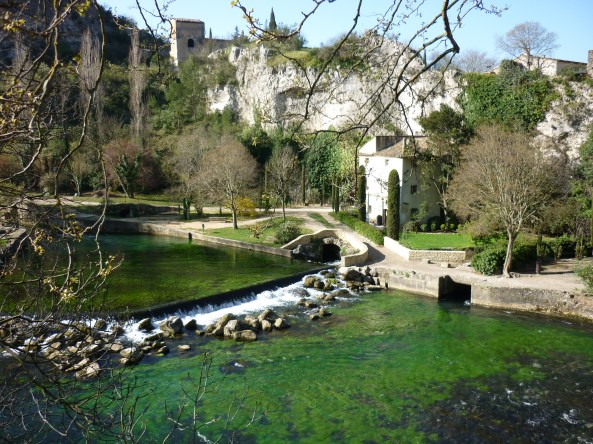
The Petrarch Museum in the white building on the right is believed to be on the site of Petrarch’s house.

This year I found myself talking about one place whenever anyone asked us about our trip to France. Sure, Nice was nice. Yes, Avignon was intriguing. Paris was bustling and full of things to see. The star of our visit was a small village that most people have never heard of.

Somewhere around 1310 Francesco Petrarca, his father and his brother made a visit to the source of the Sorgue River. It had been known for centuries as a miracle of nature. There was a hole at the bottom of a limestone cliff, a still pool, and then a raging river. Greeks and Romans had come to marvel at it in their time.  Petrarca was a boy, but he declared that this was a place he wanted to live. Some twenty years later, he bought property and spent fifteen contented years off and on living in his house on the banks of the Sorgue, trying to forget Laure, writing, and tending his books and his gardens: one at his house and another by the still pool of the spring at Fontaine de Vaucluse.

There is a magic in this place. The incongruity of the stillness and the noise. The contrast of the white cliffs and greenery. The fortress on the top of the hill that was in ruins even in Petrarca’s time. The sound of the newly born river which seems to burrow into your head and erase all hurry. The meditative nature of the place.

I could never have described it from the photographs. This is one place that one has to visit to fully appreciate. I wish I’d had more time to just soak in the atmosphere of the place.

At the Petrarch Museum, located on the site of his house, I found a comment he’d made that in the past, people had come to Fontaine de Vaucluse to see the miracle of the spring, but in the future, they’d come because he had lived there. I pointed out to my husband the enormous conceit of a man to make such an assertion. He just smirked and said, “We’re here, aren’t we?”

And so we were. If Francesco Petrarca had not been writing about Fontaine de Vaucluse in the 14th century, I would never have known about it and I would never have sought the experience. I would never have found myself sitting by the river bank as the sound of the Sorgue carried me back seven centuries. He was pompous, but he was right.  His words are entwined in the magic of the place.


ever considered? April 21, 2011

Filed under: Commentary,Writing — Shawn L. Bird @ 9:08 pm
Tags: ,

Topic #99: Have you ever considered writing a book? If so what would it be about? Make a list of the ideas you want to cover, or the themes it might have. If you’ve never considered writing a book, what other major work have you thought about (a movie? a symphony?).

Ah, yeah…  😀  Well….   Of course there’s Grace Awakening (click the link above).

Mostly, I think I’d like to stick to writing for teens and young adults.  I like themes of acceptance, love, and growth.  I like to teach something as well, so Grace Awakening is full of characters and references to Greek mythology, poetry forms, and history which gives a lot of extra dimension to the story if the reader chooses to pursue additional investigation.

I started writing a book when I was a teen.  I had the theme and some of the key characters figured out early, but it took many tries to get it into a form that worked properly.  In the six months that Grace Awakening was evolving on my keyboard, it was surprising how all the past writing wove itself into the narrative, expanding into something powerful and new. 

Everything that was becomes part of what will be.

I am presently working (or procrastinating) on two novels.  One is ‘just about finished’ (as i t has been for a year or so) and the other is the prequel to Grace Awakening.  Doing the research for that one last month in France makes me yearn for another trip.  There is so much to learn, and the words flew thick and fast while basking in all that atmosphere.  I have several other ideas floating around in my brain as well.  Once you start writing, the words bubble like a spring, and the chapters drift like a river toward a sea of story.


iloveross17 (chapter six) April 15, 2011

Filed under: narrative,Poetry — Shawn L. Bird @ 9:26 pm
Tags: , , ,

click NARRATIVE above to see all previous chapters

.

Chapter six

Log in
User name- SuzieQ
Password- confused1

CHAT ALERT!

Dave – Hey!

SuzieQ- what have u been saying?

Dave – ?

SuzieQ – about us making out?

Dave – ohh

SuzieQ – so?

Dave has left the chat

Log off