Shawn L. Bird

Original poetry, commentary, and fiction. All copyrights reserved.

We are The Borg May 31, 2010

The Shuswap Lake International Writers’ Festival is over for another year.  What a wonderful experience it was!  Last year the SAOW ran a mini festival, but this year they truly outdid themselves.  So many talented, inspiring presenters (too many, perhaps, since you couldn’t possibly get to be in every workshop you wanted to) filled our heads with information, examples, considerations,  ideas, and possibilities.  I know there are a lot more writers in the Shuswap than attended.  How sad to miss such an amazing opportunity on your doorstep!  I’m going to share some tidbits that I took away from various presenters over the next while, so stay tuned!

Today I attended a workshop with the amazing Crawford Kilian (LOVE that name! So distinguished!).   Crawford is a retired Capilano College prof who’s lived all over the world, and is published basically everywhere.  Crawford was speaking about “Techie Tools For Writers.” Essentially he showed the group how to use advanced search functions of Google.  None of this information was particularly new to me, but there is always something to take away from a workshop!  Crawford has an amazing collection of blogs on a wide variety of subjects.  Looking for information on H5N1?  Crawford Kilian is your man.  How about black pioneers in British Columbia?  How to write for the webEnglish tips?  Yes.  Crawford Kilian’s blog is the place to find everything you need.  He is astounding! 

He is also inspiring.  To maintain his many blogs is a labour of love.  They are a mixture of vocation and avocation.  He shows how a good writer uses all the resources available to him, and how being open to new technology brings your words to the world.

After Crawford’s workshop I offered my card to a writer and invited her to visit my blog.  She replied, “Oh, you write for teens so you need to do that stuff.  I don’t do that.  But thank you.”  I am still trying to figure out what she was thinking.  Crawford Kilian doesn’t write for teens.  He writes for every person on the planet.  I’m not writing for teens on my blog.  I’m writing for anyone who’s curious about the things I’m curious about.  I’m writing for anyone who wants to explore ideas and artistic perspective.  I’m writing for anyone who likes something yummy to eat!  We have technology available to us that connects us to the world and gives the world an opportunity to connect to us.  We are The Borg.  We are all part of each other in the new world of internet connectivity.  Writers need to tap the collective consciousness for the symbiosis of mutual productivity.

I’m glad to be here on the net with you, dear symbiotic reader!


Whoo hoo! I won! May 30, 2010

How delightful to be a winner of the Shuswap Lake International Writers’ Festival Cheesy Suspense Quick Write Contest. 😀

These are a fun part of writing conferences. The committee prepares an opener, and participants can create a 80 word or less ending to the story in either prose or poetry.

OPENING: It is a wild and stormy night on Shuswap Lake. No one in their right mind should be out in this. Wait! What was that? A lightning flash caught a movement on the beach! Who, or what, could it be? Whatever it was seemed to be pulling something heavy towards the water. The next lightning flash showed only an empty beach. Maybe I should investigate…

MY ENTRY:

The heavy thing splashes
Like manuscript ashes
While that thing on the beach
Is extending its reach.

In the storm a crowd gathers
And houseboat slosh lathers
The shore, when another bright flash
Shows the victim making a dash
From the whole Shuswap Watershed commission
wielding a thick anti- Smart Centre petition.

Who’s the guy fleeing the party?
I would swear it was Marty…

Apologies to those who are not local and are missing the humour! 😉 Marty is our mayor and voted for a WalMart Smart Centre to be built in a sensitive Watershed area. It’s a bit of a hot issue in the Shuswap these days! This entry should have won me a gift basket of gouda cheeses apparently. Unfortunately, since you had ‘to be present to accept your prize’ and I was having dinner with a publisher when they announced the winners, I get the accolades but not the yummy prize.    2nd place Brenda Melnachuk got to take home the cheese. Well, I may get a better prize out of a wonderful evening. We’ll just have to wait and see.


rejection letters May 29, 2010

In the May 20th blog entry, “Why I Love My Job” I told you that in grade 5 I switched my career goal from writing to teaching.  I didn’t tell you why.

In grade 3 and 4, I was a writing star.  I shared stories with my grade 3 class during show and tell, and I know I kept them on the edge of their seats with my brilliant prose.  In grade 4 I won a Mother’s Day contest with a poem I’d written.  My star was on fire.  I had nothing but confidence in my skills as a writer.

In grade 5, I shared a poem I’d written with my school librarian, Mrs. Alex Harbottle , and she suggested I send it in to a magazine.  She recommended a children’s poetry journal called Jabberwocky.  I sent off my poem.  In due course, I received a letter back from them.  Heart thudding with joyful anticipation I opened the envelope, and pulled out my first rejection letter.

Oh, it was a kind and thoughtful letter.  My poem, the editor said, was too mature for their journal.  It was a lovely poem, and I should send it on to an adult poetry magazine or a religious magazine.  They thanked me for my submission and hoped I would send them something else another time.

I was shocked.  I was 10 years old.  Why would my poem be of interest to adults or the audience of a religious magazine?   I couldn’t deal with their suggestion, and so I shut that door.

Don’t get me wrong, I was still writing poetry.  Just ask the boys who captured my interest and received beautiful hand calligraphied books dedicated to them!  I also wrote articles and a library column for the school newspaper.  That was just the end of looking for public approval until college when I discovered my fiance (who was NOT a writer) was going to enter a piece into the writing award.  I couldn’t have that!  It was only 2 or 3 hours to deadline, but I borrowed a typewriter, invented a story on the spot (typing very poorly!) and managed to win the prize.  It paid for his wedding ring.  That could have been enough  to inspire me to start sending out my words again, but it wasn’t.  I used them up on babies and students instead.  Two decades playing with the words of others at home and in a classroom.

Then I wrote a novel.  And another.

So now, after many years, I’m sending my words out for others to assess and to determine if those words can make them money and generate an audience for their company.  I’m sending off queries and talking to publishers.  The rejection letters are due.

I think I can handle it.  I did all right after 6 months of discussion with an agent led to the first rejection e-mail.  I wasn’t crushed.  I simply thought, “We’re just not the right fit.” (though I regret not letting her know I had a publisher indicate interest in the manuscript!) I was simply astonished when another query was returned with a “we have too many things on the pile at the moment, can you re-submit this later?” note.  (Note to self- possible area of career demand-literary agent).  No devastation.  No urges to commit suicide by letter opener as a result of another crushing blow.  So far so good.

I’m trying to re-frame the name.  They’re not so much ‘rejection letters’ as new opportunities to explore, right?  They’re not about me and my words, necessarily, they can be about what fits with the company and their needs.  Publishers a’re  businesses, after all.  They have to find product that matches with their vision.  It’s not personal.  It’s just business.  But those words I’ve sent out there are my babies, and I want them to be well-liked and find friends who will help them become all they can be.

I’m trying to feel brave as I send my words out.  I hope they’ll be received well. 

Last year, in response to a joyful email note I’d sent upon initial interest by an agent in Grace Awakening, an old, dear friend (who was beneficiary of a few of those calligraphied poetry books once upon a time) wrote, “You’re a writer.  You’ve always been one.”  It makes me weepy whenever I consider his simple assertion of this identity for me.  One rejection letter  in my youth made me doubt that this was my calling, but I’m claiming it again.

I am returning to the childhood quest, Mrs. Harbottle, because I am a writer.


Words May 28, 2010

Words.

We fill our days with them.  We speak them.  We read them.  They shout at us from billboards.  They whisper at us from between the notes of a song. 

 We celebrate upon a baby’s first words.  We’re empowered when we first read words.  We grieve when a stroke steals words.  We hover around a bedside to hear last words.

This weekend is a celebration of words.  I will be attending the Shuswap Writers’ Festival.  I had just finished Grace Awakening last year when I attended my first writing conference here in the Shuswap.  I thought meeting some professional writers and  mingling with the writing community was bound to be a good experience.  It was all  new. I wasn’t sure what a blue pencil was, and why I’d want to participate in it.  It was enlightening.  Every workshop offered gems.  I hung on the edge of my seat listening to Andrea Spalding share her experiences and work.  Words filled the weekend and led to more words.  On the basis of my experience I was encouraged to be brave  and travel to attend the huge Surrey International Writers’ Festival 5 months later.  That conference  was also phenomenally inspiring and led to some new writing friends and connections.

Now I will be hanging on the edge of my seat again.  What words will be shared this weekend?  Will a book sell?  Will a career launch?  Who will I meet?  What will I learn?   I am eager to meet the professionals and soak up as many of their words as I can.  I’m hoping to hear some encouraging words.

Words are waiting to change my world again.  Whose words willl they be?


language & brain May 23, 2010

The ability to speak a second language isn’t the only thing that distinguishes bilingual people from their monolingual counterparts—their brains work differently, too. … A new study published in Psychological Science reveals that knowledge of a second language—even one learned in adolescence—affects how people read in their native tongue. The findings suggest that after learning a second language, people never look at words the same way again. 

Wenner, Melinda. “The Neural Advantage of Speaking 2 Languages.” Scientific American Mind.  January 2010.

Melinda Wenner’s article in Scientific American fascinates me for many reasons.  I have friends whose children were born in bilingual environments, and it has always amazed me how  fluidly these children move between languages.  It has frequently been observed that students in French Immersion tend to be among the strongest in the school. Is this because they were already so, or have their brains been improved by second language learning?

I started learning my second language (French) when I was in grade 4.  I loved it!  It was like learning a special code, with the advantage that other people around the word could understand it, too.  In grade 12 I added a Spanish course and did very well at that at the time but, unfortunately before I could solidify it, I headed off as an exchange student to Finland, and before long even French was a struggle as my brain re-tuned to Finnish instead.  I was in awe of the students in my Finnish class.  We were the language stream, and besides Finnish (‘Äidenkieli’ or ‘mother tongue’) they took courses in Swedish, English, German, French and/or Russian.  How on earth did they manage it?  By third rotation when we came back to French class I couldn’t speak it properly anymore (I could read and understand without difficulty, but the Finnish pushed the French out of the  speaking centre).  Happily, both French and Finnish happily co-reside in my brain these days.  

While I was learning Italian earlier this year, I kept finding connections to other words I knew in Spanish, French or English which led to epiphanies of word meaning.   One epiphany resulted from learning the Italian word nebia which means fog.  Suddenly I had a whole new understanding of the English word nebulous.  While pulling on a door and reading the French tirer (to pull) I realised the connection to the word on Italian doors: tirare.  Do these words relate to the English verb to tire?  After all, it’s exhausting work to be pulling something.  What about the Italian word for ‘left’ sinistra?  The underhanded swordsman using the left hand was definitely sinister to his opponents.  All these additional layers of meaning start appearing as you read when you know other languages.

When one learns another language, or particularly several other languages, one begins to see the complex web that strings them together. If one opens up to the conceptual words that we don’t have in English, our world view expands even further.  For example, Finnish has the word sisu which connotes pride, courage, and fortitude.  The Finns claim sisu is what allowed them to decimate the Russians with 10:1 losses and led to  the only war-time settlement the Russians ever negotiated to stop the Winter War of 1939.   (It’s also the name of their strongest salt-licorice, which is fitting because it definitely takes some fortitude to eat it!)
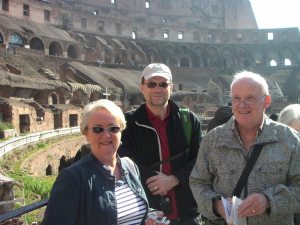
I have enjoyed studying various other languages for interest sake over the years, although I gained no significant fluency.  I studied Esperanto, Japanese and most recently Italian.  It was particularly entertaining to be sitting at a restaurant table in Italy a couple months ago with my Finnish host parents and my Canadian husband, speaking English to him, Finnish to them, and Italian to the waitress!  It was especially clear to me then what this article suggests- speaking other languages is definitely a brain work out!


musing on muses May 14, 2010

Filed under: Grace Awakening,Poetry,Pondering,Writing — Shawn L. Bird @ 4:01 am
Tags: , , , ,

Are there reluctant muses? How many muses are embarrassed or dissatisfied with their role as someone else’s creative inspiration? Whatever the real nature of the relationship between the people involved, the creative one takes the facts of the other and covers individual identity with musical notes, pieces of paper, or splashes of paint. Reality becomes illusion.

A muse is a creation of aspiration on the journey to inspiration. That they may walk, talk, breathe, sing, dance or act is extraneous to the process. The muse simply exists as a precipice from which the imagination can leap. If the muse is worthy, the leap is not downward, toward the heavy reality of life, but upward, into the dreamlike world of possibility. Once gliding on the currents of the muse, the creator may stay in the air for years or even decades on the flow of ideas, images, and imaginings

While the real life person ages, decays, and even dies, the muse lives on in perpetual youth. The ephemeral something that creates the muse is extemporal. This is why Petrarch was able to write over three hundred sonnets to Laure, even after her death. Reports suggest that the two had never actually even met, and yet the dream of her fueled Petrarch’s writing for decades after his first glimpse of her. I understand his obsession. My own muse is a memory wrapped in a dream and tied with a reverie. There’s no accounting for the flashes that make a moment into a poem, a  nuance into a novel or a suggestion into a song.

From delusion
to illusion,
with the inspiration
comes the aspiration
for imagination
to become creation.