I am aware that I am among the most blessed people on the planet because I absolutely love my job. Every day when I walk into the high school where I teach, I enter a dynamic world that is constantly new and constantly entertaining. The challenges are many, but the rewards are greater. There are only six more weeks of classes this school year, and as I prepare to bid farewell to this year’s kids and enter my annual two months of unemployment, I am pondering on how I got here, and what makes my job great.
I have not been out of school for more than six months since I was three. That’s when I began my love of learning at Mrs. Hamilton’s Bo Peep Kindergarten. My mother needed me out of the house. I think I was exhausting. I spent three years with Mrs. Hamilton, and several of the students in the kindergarten graduated with me at Okanagan Mission Secondary thirteen years later. I loved elementary school (all four that I attended) and even junior high, because I had great friends and I was curious. I loved learning new things and I had a lot of questions. In grade three, I loved writing stories and sharing them in show and tell. I planned to be a writer. I was about ten when I decided I was going to become a teacher instead. I planned to teach grade four or five. My grade four teacher, Mr Lavoie, and my grade five teacher, Mrs Nemeth, had completely opposite teaching styles but I adored them both. I was completely inspired to follow in their footsteps.
Although I had amazing teachers in a brand new school in a lovely forest setting, until grade ten, life in high school was not pleasant. I spent a lot of time writing poetry and long letters to friends in other places. I read constantly. I invented stories on my walk to and from school. I wasn’t a loner though; I belonged to youth groups, choirs, and volunteered hundreds of hours at the hospital. I belonged to a lot of school clubs: library, newspaper, yearbook, and musical theatre. I had an active, busy life. In the senior grades the students became respectful and tolerant of others again, and high school became much more pleasant. At this point I returned to the debate. Should I return to the dream of being a writer or stick with the plan to be a teacher? I had some inspiring teachers in high school, like Mr. Keith, Mr. Swanzey, Mr. Wendell, and Mr. Moore. You may notice that some of those names appear in Grace Awakening. This is a small tribute to their influence, although the characters are flat and not at all the intelligent, innovative and inspiring people these men were in real life! It wasn’t until I entered teacher training and started observing in other schools that I realised what an amazing vision our principal Mr. Monteleone had for us at OKM.
I was still planning to teach elementary and I was in University of Calgary’s education department working toward that goal when a new life got in the way. Time to re-think the plan. We were moving to northern BC where there was no university at the time, so I transferred my credits to Athabasca University, an international leader in distance education, which would allow me to continue my studies anywhere in the world. It took several years, but eventually I earned a BA in English. Next I had to figure out how to earn my teaching credentials. The solution was an innovative program offered by Simon Fraser University to train teachers in the communities where they lived. Because I had a BA already, and was missing some of the general credits needed for elementary (like old nemises math and PE), I had to re-think my planned teaching level. I did my training to be a high school teacher instead. Although I hadn’t expected to focus on that level, I discovered that I really enjoyed working with teens. Being flexible at every stage allowed me to reach my goals, and it stood me in good stead as I taught a wide variety of subjects in countless subbing jobs and temporary teaching contracts.
My students come from all walks of life. They each have unique challenges and goals. They are fascinating and fun to be with every day, despite the frustrations of trying to get them to live up to potential some of them don’t want to reach. I mourn with them when tragedy touches our world. Loss of our kids before or after graduation due to accident or illness always devastates. Too much potential is lost when a young person dies. Most days are celebrations though, and no one knows how to celebrate like teens! No school day or even hour is the same. The students ensure my days are never boring, and their energy provides fuel for imagination. Each one offers me information about the world and growing to understand their needs and talents inspires me. I get to share great works of literature with them and coax their awareness and understanding of universal themes. I get to see skills develop as students learn to manipulate words in prose and poetry. I get to watch them grow through the years and graduate into adult life, where I hope that they carry gleanings of ideas from my classes that will fuel curiosity and engagement with learning throughout their lives. I’m always so happy to hear from students, even though lately I have trouble remembering their names from semester to semester!
So here I am today, in my eighteenth year of teaching high school, looking out my classroom window over the trees to Shuswap Lake shimmering in the sun. I live in one of the most beautiful places in the world and I’m blessed to have one of the most fulfilling jobs in the world. Life couldn’t get much better.







language & brain May 23, 2010
Tags: bi-lingual, brain, languages, Melinda Wenner, Scientific American, The Neural Advantage of Speaking 2 Languages
Melinda Wenner’s article in Scientific American fascinates me for many reasons. I have friends whose children were born in bilingual environments, and it has always amazed me how fluidly these children move between languages. It has frequently been observed that students in French Immersion tend to be among the strongest in the school. Is this because they were already so, or have their brains been improved by second language learning?
I started learning my second language (French) when I was in grade 4. I loved it! It was like learning a special code, with the advantage that other people around the word could understand it, too. In grade 12 I added a Spanish course and did very well at that at the time but, unfortunately before I could solidify it, I headed off as an exchange student to Finland, and before long even French was a struggle as my brain re-tuned to Finnish instead. I was in awe of the students in my Finnish class. We were the language stream, and besides Finnish (‘Äidenkieli’ or ‘mother tongue’) they took courses in Swedish, English, German, French and/or Russian. How on earth did they manage it? By third rotation when we came back to French class I couldn’t speak it properly anymore (I could read and understand without difficulty, but the Finnish pushed the French out of the speaking centre). Happily, both French and Finnish happily co-reside in my brain these days.
While I was learning Italian earlier this year, I kept finding connections to other words I knew in Spanish, French or English which led to epiphanies of word meaning. One epiphany resulted from learning the Italian word nebia which means fog. Suddenly I had a whole new understanding of the English word nebulous. While pulling on a door and reading the French tirer (to pull) I realised the connection to the word on Italian doors: tirare. Do these words relate to the English verb to tire? After all, it’s exhausting work to be pulling something. What about the Italian word for ‘left’ sinistra? The underhanded swordsman using the left hand was definitely sinister to his opponents. All these additional layers of meaning start appearing as you read when you know other languages.
When one learns another language, or particularly several other languages, one begins to see the complex web that strings them together. If one opens up to the conceptual words that we don’t have in English, our world view expands even further. For example, Finnish has the word sisu which connotes pride, courage, and fortitude. The Finns claim sisu is what allowed them to decimate the Russians with 10:1 losses and led to the only war-time settlement the Russians ever negotiated to stop the Winter War of 1939. (It’s also the name of their strongest salt-licorice, which is fitting because it definitely takes some fortitude to eat it!)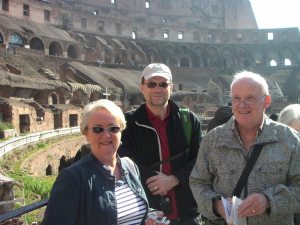
I have enjoyed studying various other languages for interest sake over the years, although I gained no significant fluency. I studied Esperanto, Japanese and most recently Italian. It was particularly entertaining to be sitting at a restaurant table in Italy a couple months ago with my Finnish host parents and my Canadian husband, speaking English to him, Finnish to them, and Italian to the waitress! It was especially clear to me then what this article suggests- speaking other languages is definitely a brain work out!
Share this: