
Today’s offering, a musical interlude by my harp friend and teacher Sharlene Wallace of Toronto. Enjoy!
.
http://music.cbc.ca/#/artists/Sharlene-Wallace
Trembling December 28, 2011

rare and amazing…;-) April 13, 2011
Topic #95: What rare talent do you have that most people don’t know?
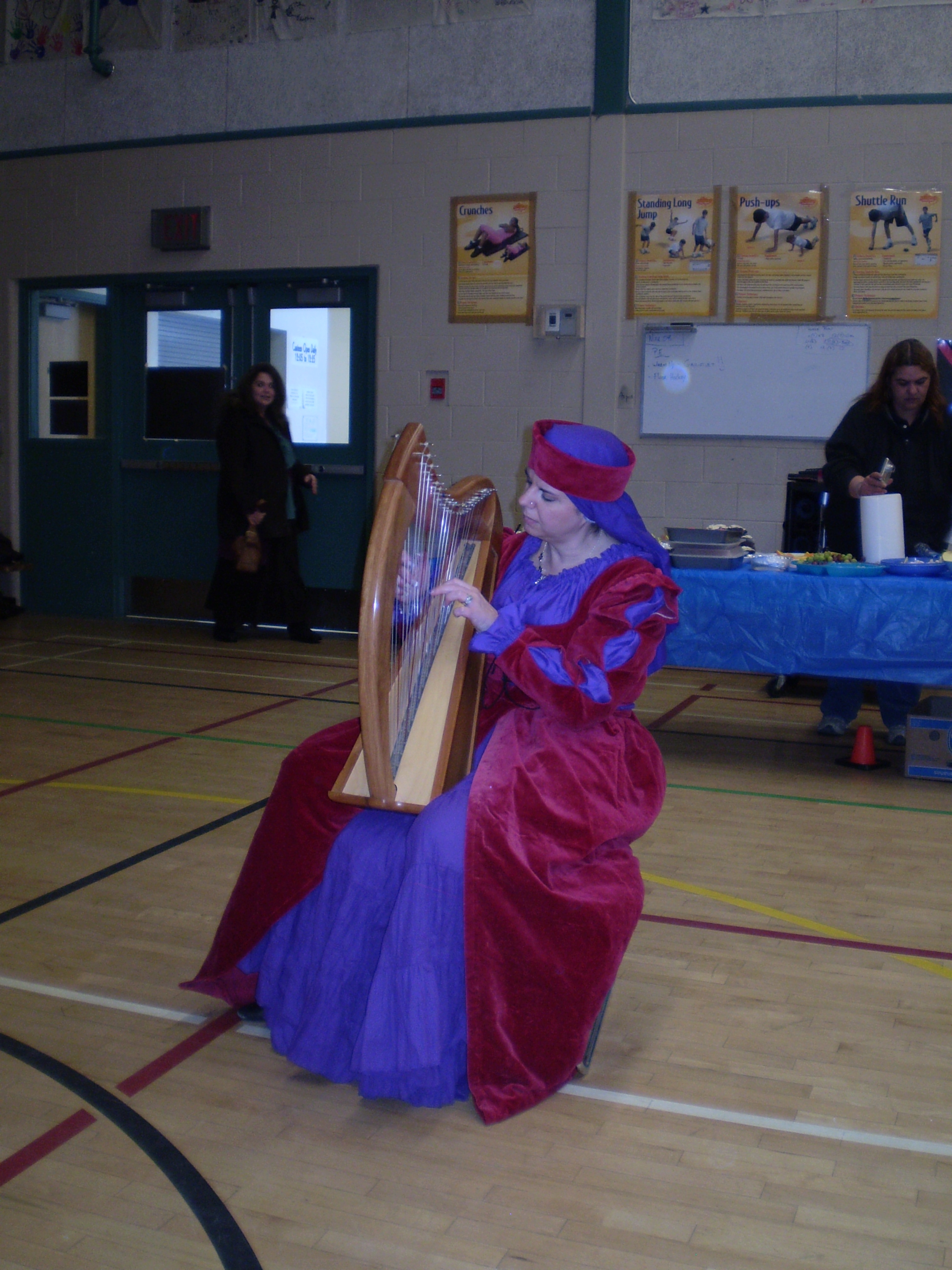
Carlin Medieval Feast
I have many skills that are a little out of the norm, but the one that seems to surprise people the most, is playing the harp. To you loyal readers of this blog, this is old news. Did it surprise you? Of course, I rarely practise these days, and so my skill level is deteriorating at a dramatic rate, but that doesn’t seem to matter. The fact that I own two harps and can make some semblance of music with them causes amazement. I confess, when I take a harp out in public and pluck the first strings, I am regularly astonished at how silent the room will become. I played a couple of old tunes at a Middle School Medieval Feast last month, and I couldn’t believe how silent Middle schoolers could be!
For the record, it’s not hard to play a harp. The tuning of 33 or 44 strings is a bit of a pain, but the actual playing isn’t so terrible. If you can play a piano or read both treble and bass clef, you can read the music easily. Learning how to pluck will take only an hour or two to learn. Of course, putting it all together requires skill, but that’s about practice, not about inherent difficulty. A harp is no more difficult than a violin or an accordion to learn; you just sound much, much nicer while developing your skill! 😀
.
PS. If you are interested in learning to play the harp and either renting or buying one, click on BC Harps on the top of this page for links to teachers, stores and harp makers.
harping in Mexico January 6, 2011
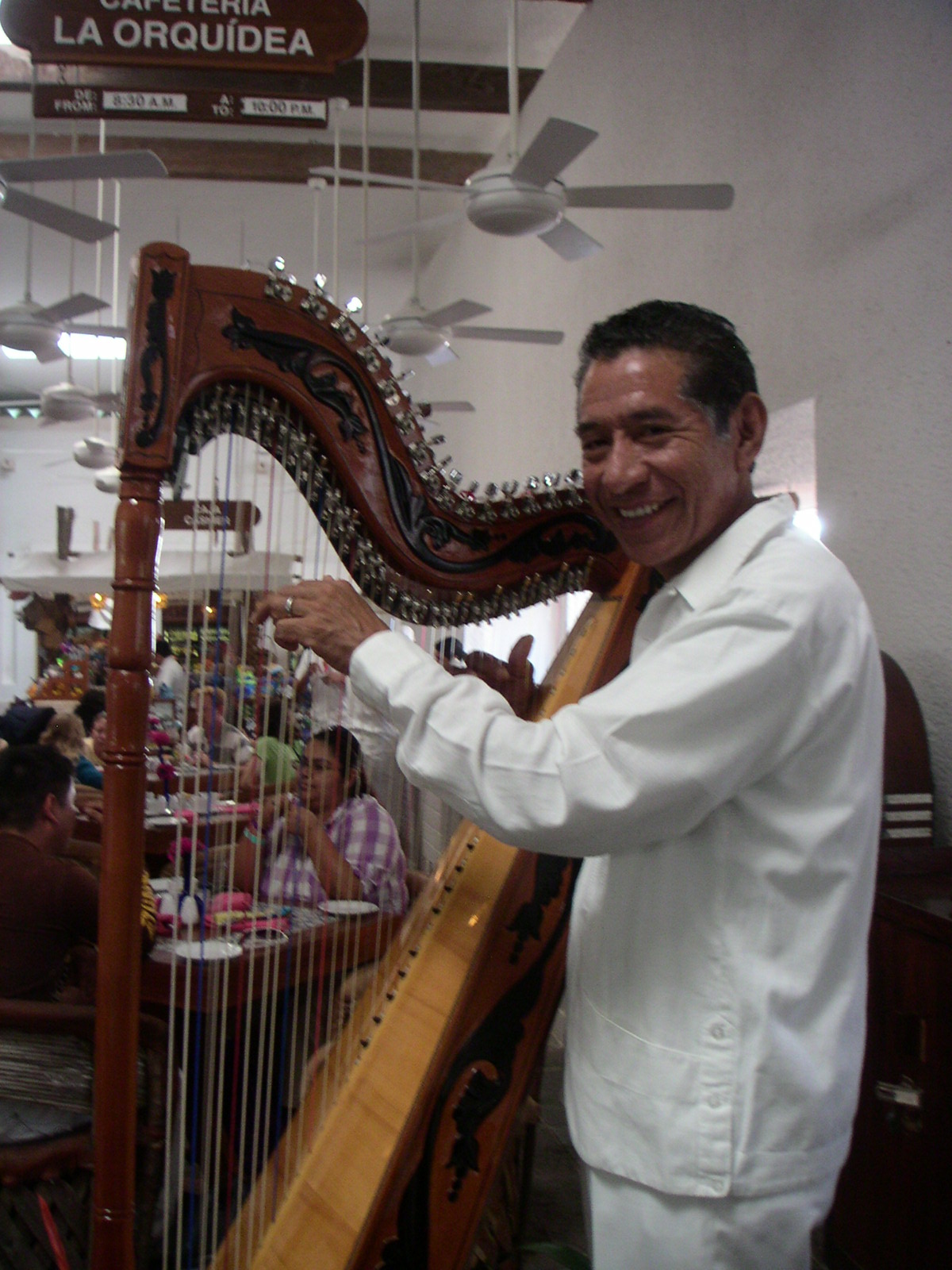
Guatalupe Torres
I had the privilege to listen to and to meet a talented Mexican harpist last week. He is Guadalupe Torres and he performs regularly at XCaret in Riviera Maya. XCaret is a destination park that offers all sorts of snap shots of Mexican history, flora, fauna, and music. I think Sr Torres’ hour long concert in the Orchid Cafe was the highlight of my week in Mexico. Because I didn’t want to sit in the cafe (I didn’t have any money to buy even a coffee) I stood near his playing platform and watched up close as he played. (Nothing too intense, having someone stare at you from 2 feet away while you play!) Torres was not amplified and the cafe was very loud, so I think I may have been the only one who could hear anything at all.
He has a repertoire of tunes that ranged from Latin to classsical to pop. His touch is light and sure. He played what I would call a Paraguayan harp. but which his CD calls “arpa Latinoamericana.” There were full levers and a very interesting triple harmonic curve (you can see two layers of it in the photo). I wish my Spanish was strong enough to ask him how on Earth he changes strings with a basically solid backed harp! After the concert Torres invited me to try out his harp, which was a little embarrassing considering a) my lack of practice b) my long gel nails c) the narrow string spacing and d) key (I was trying to play a tune in C, but the harp was tuned in G). Nonetheless, it was sweet of him, and I thoroughly enjoyed our stilted mixed language conversation.
I’ve found him on Youtube for you. The sound quality isn’t great, but you can get an impression of the traditional Latin style and his skill. I’m sure you can find MP3 tunes that are cleaner. Take a listen and enjoy a sound of Mexico much more pleasant than the shrieks of an irritated jaguar or a hungry howler monkey!
You can download MP3s from here:
http://music.napster.com/artist-music/tracks/12803175/?artist_id=12803175





 Shawn L. Bird
we are the music May 24, 2011
Tags: Charles de Lint, harp, healing, music, postaday2011, therapy
(I told you I’d have something to say about this eventually, didn’t I?)
I am fascinated by music therapy. You may be thinking of the research that shows how music connects for Altzheimer’s patients, but that’s not what I mean.
In the harp community research has been done on how sound waves align cells, and can induce healing at the molecular level. It’s rather profound and quite amazing. Playing the harp is a rather meditative thing. With your legs and arms wrapped around the sound box , the sound waves travel through your body. You can feel it. Certain notes can make your head tingle or your spine stretch. You can feel the music reaching inside your arms and legs and relaxing or awakening your body. This is why harp therapy exists. With a harp tuned in a pentatonic scale (five notes, all complimentary) it is impossible to make any dissonance, and even bed-bound patients can hold a small harp against their chest, strumming or plucking and absorbing those sound waves.
Some innovative hospitals include such therapy in their medical teams.
Sonic therapy, The Harps of Lorien, and International Harp Therapy are just some of the projects that explore the magic and mystery of this form of healing and transition therapy. I’m so glad that I have my harps and have the opportunity to sit and absorb the science of the universe whenever I want.
Music is a miracle and we are part of its resonance in the world.
Share this: